Claude Code vs Antigravity: 100 Hours Testing Both — Which Should You Learn?
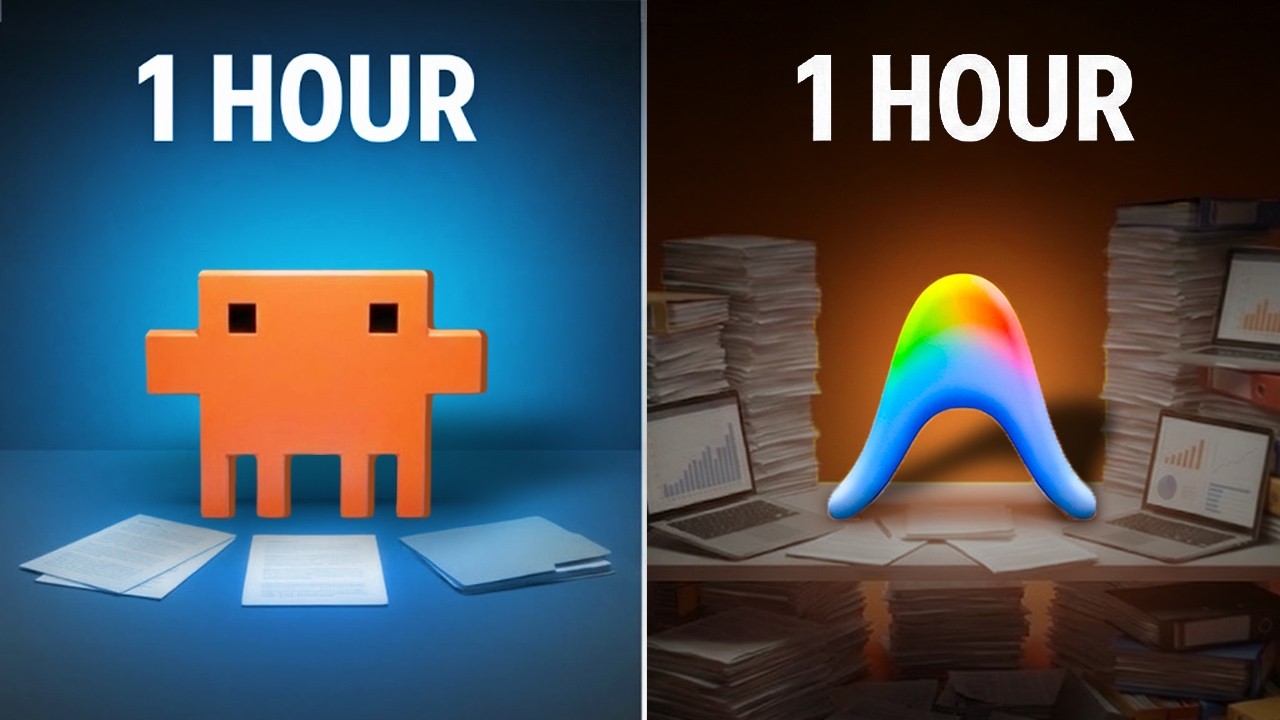
Nate Herk spent 100 hours with both Claude Code (Anthropic) and Google's Antigravity (Gemini-powered) to settle the debate. The answer isn't a clean winner — they're architected differently and excel at different tasks. But he does name one to learn first, and explains exactly why.
"100 Hours Testing Claude Code vs Antigravity" by Nate Herk — Watch on YouTube →
Key Takeaways
- Both tools have the same core capabilities: break a large mission into a plan, spin up sub-agents in parallel, manage files and folders, run terminal commands, and execute across an entire codebase. Neither is fundamentally limited relative to the other.
- Neither Claude Code nor Antigravity costs money by itself — you pay for model tokens (the AI behind the scenes). Claude Code defaults to Anthropic's Claude models; Antigravity defaults to Google's Gemini models. Both support model swapping with some configuration.
- Claude Code is terminal-first: a CLI tool that plugs into your existing environment. You keep your editor, key bindings, and extensions. The agentic power is surfaced through the terminal and configured entirely by you. You build the workflow on top of the tool.
- Antigravity is a standalone IDE — considered a VS Code fork, so extensions and shortcuts carry over, but you are opening a different application. Its key differentiator is the manager view: a dedicated interface for watching multiple agents work in parallel across different workspaces. It also ships with a built-in browser agent that can navigate real web pages.
- The simplest framing: "Claude Code gives you the primitives and lets you work the way you already work. Antigravity packages the whole agentic workflow thing into a purpose-built environment that you kind of move into."
- After 100 hours, Nate's recommendation: learn Claude Code first. The deeper understanding of agentic primitives you develop working in the terminal transfers to any tool. Antigravity's convenience can become a ceiling if you haven't built that foundation.
Architecture Comparison
| Dimension | Claude Code | Antigravity |
|---|---|---|
| Interface | Terminal / CLI | Standalone IDE |
| Default model | Anthropic Claude | Google Gemini |
| Parallel agents | Yes (configured) | Yes (manager view built-in) |
| Browser agent | Via MCP | Built-in |
| Customisation | Full (skills, hooks, MCP) | More opinionated |
| Learning curve | Steeper | Lower entry barrier |
Related on OpenClawDatabase
- Claude Code vs Claude Cowork — comparison within the Claude ecosystem
- OpenClaw Setup Guide — getting started with Claude Code
- Skills Guide — how to extend Claude Code with custom capabilities
What you can actually set up from this
Extracted from the video's own transcript — the specifics the original summary left out.
Reproducible steps
- The structural difference, before any benchmark
Claude Code is terminal-first — a CLI that plugs into the environment you already use, so your editor, keybindings and extensions stay put. You build the workflow on top of the tool. Antigravity is a standalone IDE (widely taken to be a VS Code fork), so extensions and shortcuts carry over but you are opening a different application. It has a manager view showing multiple agents working in parallel across workspaces and a built-in browser agent. One gives you primitives, the other gives you an environment to move into.
- Entry points differ sharply
Claude Code has four: the terminal CLI (installed with npm, the most feature-complete mode), a VS Code extension with inline diffs and plan review, a desktop app, and a browser version with no install. A few advanced features are CLI-only. Antigravity has one front door — you download the app; its CLI command only launches the IDE.
- Where each is stronger
Claude Code's advantages are planning depth (a read-only plan mode that maps multi-file work and asks clarifying questions before touching anything, with adjustable reasoning depth) and codebase fit — it reads existing patterns and naming conventions so generated code matches rather than feeling bolted on. Antigravity's advantage is building full apps and front ends from scratch, and specifically design taste on UI/UX work.
- Both let the model do the deciding
Claude Code defaults to Claude models, Antigravity to Gemini; both can be switched with some configuration. Both tools are free — you pay for tokens. The harness shapes how the model works, but the model sets the ceiling, so a comparison between the tools at different model tiers tells you almost nothing.
Gotchas
- <strong>Antigravity drifts from its own rules on long projects.</strong> It can build perfectly to spec on day one and gradually ignore the original guidelines by day three. This is a documented pattern with a thread on Google's own developer forums. The presenter notes it is broadly true of any coding agent, but calls it out as more pronounced here.
- Benchmark figures cited, with their caveat: Claude Opus 4.6 in Claude Code at 80.9% on SWE-bench Verified against Gemini 3 Pro in Antigravity at ~76.2%. Both are full harness-plus-model scores, and Google has not published its testing methodology the way Anthropic has, so this is not apples to apples.
- Productivity claims, neither of which is a controlled study: Anthropic's engineering team reported a 50% productivity gain and 67% more pull requests merged per engineer per day; an independent 21-day test across 12 projects reported 60-70% faster development for Antigravity, 94% of generated code passing linting clean, and 73% of tasks completed with no human intervention.
- <strong>Both have burned users on cost or quota.</strong> Claude Code had a caching bug in March 2026 that inflated token costs by roughly 10-20x, draining Max-plan session limits in under two hours. Antigravity's quota system has locked Pro users out for a full week after hitting limits, on a credit system that does not clearly explain what a credit buys.
- Maturity gap: Claude Code is production-released with multiple updates per week. Antigravity was still in public preview as of April 2026, with reported login issues, Windows bugs and agents getting stuck in loops.
- One independent task-speed test had Claude Code at ~4 minutes against Antigravity's ~8 — which contradicted the presenter's own impression that Antigravity felt faster. Worth noting as a case where a single measured number disagrees with lived experience.
- Context loss is real on both, even at a 1M-token window, once you are 40+ prompts deep with heavy tool use on a real codebase.
More OpenClaw & Claude Code news
 A fully local agent with tools, in about 40 lines: Ollama plus Pydantic AI
 Running Nex-N2.5 Mini on two H100s: the SGLang container setup, and an honest benchmark read
 Semantic grep cut agent tool calls 58% and input tokens 47% in the project's own benchmarks
 The instruction ceiling moved 10x in a year: 200 rules became 2,000
 How LinkedIn made coding agents work on 1,000+ internal repos without fine-tuning
 Two context approaches that look right and stall: the curated-context trap and the MCP plateau
← Back to News digest · See also: OpenClaw guide