Last updated: 2026-09-11

OpenClaw & Claude Code News & Video Summaries

Every OpenClaw story we've covered — releases, tutorials, and analysis, summarised from the community and the official changelog. 219 and counting. New summaries are published as videos drop.

Looking for guides instead? See the OpenClaw hub.

The instruction ceiling moved 10x in a year: 200 rules became 2,000

A re-run of the IFScale benchmark against current frontier models. A year ago models started dropping instructions at 200-300; today the boundary is closer to 2,000 and the best reach 5,000. The failure modes also changed, and one of them is a refusal rather than a forgetting.

ACP is MCP's missing half: a standard for telling a harness what to do

An MCP maintainer argues that agents have a standard for reaching out to tools but none for client software to control the harness itself, and presents the Agent Client Protocol — its design, its new remote transport, and what becomes possible once every piece of the stack can be moved.

A browser agent with two kinds of skill file — yours, and everyone's

A walkthrough of Retriever, a browser-based task agent, focusing on the part worth knowing about regardless of the tool: it keeps personal skills as editable markdown describing how you want to work, and a separate set of shared website skills capturing how to navigate a given site.

Running agent swarms with hard spend caps, and why the answer is a sandbox

A working demonstration of self-hosted agent swarms, from a one-agent hello world to 30-agent runs, each pinned to a specific model with an explicit dollar ceiling. The framing is deliberately unglamorous: swarms are viable, expensive and dangerous, and the controls matter more than the capability.

OmegaClaw tested: a symbolic-logic agent installed with one Docker command

A hands-on install and test of OmegaClaw, an open-source agent framework from SingularityNET whose core runs on a formal symbolic layer rather than wrapping a model in Python. The run verifies the two claims that matter: memory that survives a container restart, and a symbolic reasoning layer that computes a confidence value rather than asserting one.

GPT-6 Astra vs Fable 5.1 across 15 use cases, with cost and time for each

A head-to-head of GPT-6 Astra and Claude Fable 5.1 across fifteen everyday tasks, recording which model produced the better output plus the wall-clock time and dollar cost of each run. The consistent structural finding is that Astra asks clarifying questions before starting where Fable takes the prompt and runs.

GPT-6 Astra vs Fable 5.1: five identical builds, and a looks-versus-works split

The same five prompts given to GPT-6 Astra and Claude Fable 5.1 in parallel — a full-stack CRM as a native Mac app, a Notion clone, a clothing brand storefront, a 3D city model, and an Age of Empires II replica. Every session produced a working app with no steering, and the differences fall into a consistent pattern.

The five pieces of a real agent: harness, MCP, skills, sandbox, production layer

A plain-English breakdown of what an agent is made of beyond the model — the harness that runs the loop, MCP as the tool protocol, skills as loaded-on-demand instructions, the sandbox for code execution, and the production layer of subagents, approvals and observability — followed by a live build using an open-source harness.

Four documented ways to prompt Fable 5.1 that cut how fast you burn your limits

Four prompting techniques pulled from Anthropic's own Fable 5.1 documentation, with the supporting quotes: describe the finished state rather than the task list, match effort level to the work instead of leaving it on high, make the model verify its own output before handing it to you, and delegate to parallel subagents so the flagship drives strategy rather than doing the work.

Inside an agentic engineering setup after 6,775 sessions

A full walkthrough of one practitioner's agentic engineering stack: the interfaces used to run many agents at once, how to combine subscriptions instead of paying API rates, and a step-by-step build of self-hosted cloud agents on a VPS driven entirely by an agent in plain English.

Fable 5.1's published benchmarks: AutomationBench nearly doubles

A same-day read of Anthropic's published benchmark numbers for Fable 5.1 against Fable 5, Opus 5 and GPT-5.6 Sol, with the business-workflow score standing out — AutomationBench moves from 17.1% to 31.4%, roughly doubling — plus the shift toward measuring cost per task rather than cost per token.

Give any coding agent a spoken reply using a CLI and a Stop hook

A small, portable trick: install a text-to-speech CLI, then instruct your coding agent to invoke it when a task finishes so it speaks a one-or-two sentence summary and a next-step question instead of adding to a wall of text. Works across harnesses because the agent is just running a command.

OpenClaw 2.0 review: the upgrade broke, and the new features are web-app only

A critical review of OpenClaw 2.0 from someone who left the project four months ago over update reliability. Covers the eight headline features, the in-place upgrade failing again and forcing a clean install, and the significant limitation that most of the new functionality exists only in the web app.

Setting up a Grok Bot agent team: descriptions, delegation and routines

A full setup walkthrough for Grok Bot, xAI's always-on agent product, from a fresh account to a working multi-agent team. Covers the fields that actually control routing between agents, the shared-computer model behind each bot's own screen, scheduled routines with their trigger options, and an org topology that avoids one overloaded mega-agent.

One Server for Every Model Your Agent Needs: SIE Walkthrough

Fahd Mirza installs the Superlinked Inference Engine on a local GPU box and runs embeddings, re-ranking, entity extraction, and text generation through one client — encode, score, extract, generate — with models loaded on demand.

Fusion Harness V2: Three Models Debating Inside One Agent

IndyDevDan walks through three multi-agent orchestration commands — opinion, debate, and collaborate — that run several models against one prompt, with per-run cost figures and the model-aliasing gotcha that stops agents sabotaging each other.

DeepSeek Harness vs Claude Code After a Week of Real Use

Nate Herk runs DeepSeek's open-source harness against Claude Code on identical prompts and the same model — 50 seconds vs 5 minutes on search, 3 minutes vs 17 on a deliverable — plus its four modes, its context injection, and the preview bugs.

Inside Uber's Agentic SDLC: The Six Building Blocks Behind 70% Agent-Written PRs

Uber's engineering leads walk through the six platform pieces behind their "software factory" — a model gateway, an MCP gateway with four generations of token optimisation, pre-provisioned agent dev pods, a 2,500-skill marketplace, a 40M-node context graph, and the assistant that ties them together.

Context as Code: Inside a Markdown-First Agent Content Machine

Alex Lieberman and Dan of 10X break down a content pipeline built entirely from skills and markdown — a process layer in git, a personal voice layer on disk, six interviewer personas as six skills, an editor council with a 9-out-of-10 gate, and a lessons file the agent re-reads before every write.

Ground Your Agent in a Public Schema, Not an Invented One

A healthcare-claims talk with a transferable lesson for any agent builder: constrain the agent's output to an existing public standard instead of a model-invented schema, move memory out of local files, and treat every external system as untrustworthy by default.

Claw Patrol: the byte-level agent firewall Deno runs in front of OpenClaw

Ryan Dahl on giving OpenClaw read-write access to production Postgres, Kubernetes, ClickHouse and AWS — and the MIT-licensed proxy Deno built so that is survivable. Parses every byte below HTTP, understands the Postgres wire protocol, injects credentials the agent never sees, and routes approvals to Slack or an LLM judge.

System design for a multi-agent PR reviewer: the five-move loop

A repeatable five-move design loop for agent systems — map the human process, define a precise trigger, assign component types, set the autonomy level, then sweep for failures — applied to a multi-agent pull-request reviewer with concrete mitigations for each failure mode.

Mining agent traces: LangChain's loop for improving agents with data

LangChain's applied research lead walks through a four-step loop for improving agents from their own trace data: ship it, collect traces, mine them with agents, then run experiments. Includes the harness-engineering-before-fine-tuning rule and why pass/fail scores are a weak signal.

Delete your skills and re-test: unhobbling Opus 5 with fewer instructions

Anthropic deleted over 80% of Claude Code's system prompt for Opus 5, and recommends you periodically delete your CLAUDE.md, skills and hooks too. Nate Herk ran the A/B on his own repo — here's what to strip, what to keep, and how to rewrite a skill so it stops getting in the model's way.

Software factory pattern: agents plus deterministic code

IndyDevDan rebuilds his open-source "super simple software factory" — AI developer workflows that chain specialised agents together with deterministic Python between each phase, configured by a single YAML file and installable into any codebase as a skill.

The five levels of AI builder (analysis, not a how-to)

Analysis, not a how-to: Nate B Jones maps five levels of AI builder and argues that OpenAI and Anthropic launches only feel threatening at the bottom of the ladder — plus the specific move that gets you from each level to the next.

Why bad Claude skills burn your context — and how to fix them

Nate B Jones explains why installed skills often do nothing: agents load only a skill's name and description up front, so a vague description never fires and a bloated one crowds out real work. Principles and an audit habit — no commands shown.

Buzz: Block's Open-Source Slack Where Humans and AI Agents Share Channels

Buzz is an open-source, self-hosted collaboration platform from Block that puts humans and AI agents in the same Slack-style channels. Agents are @mentioned like colleagues, run on Codex, Claude Code or Goose harnesses via the Agent Client Protocol, and can hand work to each other.

Running a Newsletter Business With a Team of AI Agents (Full Build)

Tech With Tim builds an entire newsletter operation — research, drafting, scheduling, social posts, and analytics — run by a team of collaborating AI agents coordinated from Telegram, with 24/7 scheduled tasks and a cost comparison against hiring a contractor.

Claude Code for Non-Coders: Build a Real App With Plan Mode

David DeWinter (partnering with Anthropic) shows how a non-developer can use Claude Code as a general AI agent — building a working sales-pipeline app inside VS Code with plan mode, permission modes, @-file references, and slash commands like /rewind.

Buzz: Block's Open-Source Workspace Where AI Agents Are Team Members

A hands-on walkthrough of Buzz — Block's Apache-2.0 workspace on the Nostr protocol that treats AI agents as first-class teammates with cryptographic identity, permissions, and a signed audit trail. Agents run locally via your Claude Code or Codex install. Full setup, Git side, and self-host.

Claude Code for Beginners: The Harness Mindset and 6 AI Skills

Nate Herk's beginner course explains what Claude Code actually is — a harness that pairs an AI model with your context — then walks through six AI skills to future-proof your career: being the AI person, taste, context engineering, iteration speed, and building your own Jarvis.

Fable 5 Bossed 20 Cheap Agents to Build a Site for $8

Nate B Jones shows a multi-agent 'org chart' where Claude Fable 5 only plans and reviews while cheap models do the coding — a production site for ~$8, with checker agents catching four failures and zero human fixes.

Make Opus Think Like Fable: Build a 'Fable Mode' Skill

Nate Herk shows how to extract Fable 5's working discipline into a reusable 'Fable mode' skill file — five gates plus model routing — so cheaper models like Opus 4.8 reason with the same rigor at a fraction of the cost.

Fable 5 'Context as Image' Hack: Cut Input Tokens 30–60%

Nick Saraev demos a Claude Code / Fable 5 cost hack: render bulky context as a tiny legible image so image billing (fixed by pixel size) beats text token billing — ~30% off general prompts, up to ~59% on large retrieval queries.

SpatialClaw: NVIDIA's training-free code-writing spatial agent

NVIDIA and KAIST's SpatialClaw is a training-free spatial-reasoning agent that writes and runs Python one cell at a time instead of committing to a fixed program or JSON tool calls. Here's how the loop works and why it beats prior agents by 11.2 points.

The Agent Skeleton: One Structure for Email, Insurance & Taxes

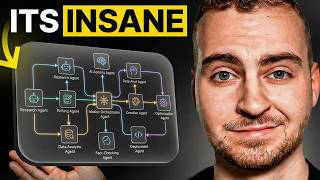
Nate B Jones builds one reusable 'agent skeleton' — context pack, ingest, chunk, normalize, store, retrieve, cite, export, gate — and applies it to email, insurance appeals, and taxes. A context-engineering framework for high-trust agent work.

4 Claude Code Upgrades That Make It Actually Make You Money

Nate Herk's four Claude Code upgrades: a /roast persona council to kill sycophancy, a Playwright verification loop, a /session-handoff skill to beat context rot, and parallel sub-agents with a /goal command judged by a separate evaluator.

Claude Code for SEO: Rank Using Your Own Search Console Data

Julian Goldie wires Claude Code into Google Search Console via the Workspace API so it builds keyword strategy from your real impressions, clicks and positions — plus an Obsidian 'second brain' for context and a multi-article publishing pipeline.

Who Owns Your AI Agent? The Maintenance Skill Teams Skip in 2026

Nate B Jones argues the critical 2026 agent skill isn't building — it's ownership and 'care and feeding.' Any system that reads real context, produces work you act on, or touches a shared workflow needs a named owner. He gives a simple operating model: give each agent a job, a diet, boundaries, and a review loop, plus an 'owner card' / agent registry for teams.

Open Skills: Portable, Composable Agent Procedures Across Every Tool

Nate B Jones launches Open Skills — a public library of 31 reusable agent procedures (plus 7 runbooks) packaged as skill.md files that travel across Claude Code, Codex, Cursor, and any harness. The pitch: stop re-explaining how you work to every new agent — encode procedures once, scope them, compose them into runbooks, and bake verification into the contract.

How to Set Up GLM 5.2 in Claude Code (~5x Cheaper Than Opus)

Nate Herk swaps Claude Code's model engine for Z.AI's open-source GLM 5.2 by editing one settings.local.json file — routing ANTHROPIC_BASE_URL to Z's API. He covers pricing (~5x cheaper than Opus 4.8), where GLM wins and loses against Opus, and a per-directory trick to keep GLM and Opus projects side by side.

The 5 Levels of a Claude Code Second Brain (Memory & Context Engineering)

Nate Herk breaks the AI 'second brain' into five levels — from a simple CLAUDE.md router and markdown folders, up through LLM wikis, semantic/vector search, knowledge graphs, and full autonomy. The key lesson: pick the lowest level that solves your actual pain, and design your folders around how you'll retrieve the data later.

Idea to Deployed AI App with Claude Code, the Vercel AI SDK, and design.md

Developers Digest walks through his go-to stack for shipping an AI app fast: Claude Code scaffolds a Next.js + Vercel AI SDK ChatGPT-style clone, routes models through the Vercel AI gateway, and then deploys it end-to-end — creating a private GitHub repo and wiring up auto-deploy on every push — all driven by natural language with almost no hand-written code.

GLM-5.2 vs Opus 4.8 in Claude Code: Near-Parity Output at a Fraction of the Cost

Nick Saraev pits the open-weight GLM-5.2 against Opus 4.8 across roughly 40 creative coding scenes — 3D/WebGL, interactive explainers, dashboards, landing pages and mini-games — and finds GLM frequently matches or beats Opus on visual "taste." He then walks through the simplest way to run GLM-5.2 inside the Claude Code harness (plus Open Code and Crush) via OpenRouter, and ranks the most cost-effective providers.

Build 3 Production AI Agents in Python with AgentSpan: Memory, RAG, and Orchestration

Tech With Tim builds three Python agents on the open-source AgentSpan framework — a conversational agent with memory, a RAG agent over a company database, and a multi-agent orchestrator — each written line by line. The focus is what makes an agent production-ready: durability across crashes, retries, human-in-the-loop, observability, long-running tasks and scale, all handled by a local AgentSpan server.

Rank #1 with OpenClaw + Hermes AI SEO Agent Swarm

A multi-agent SEO system using OpenClaw and Hermes automates keyword research, content writing, and WordPress publishing on a schedule. A 12-agent swarm handles competitor analysis, technical SEO, and backlink planning simultaneously.

Run Claude Code Free with OpenRouter in 5 Minutes

A free middleware project bridges Claude Code to any model on OpenRouter, including free-tier options, in about five minutes. Install a helper, add an OpenRouter key, and run Claude Code normally — no paid subscription required.

How to Build a Claude Opus 4.8 AI Operating System

Nate Herk shares his four C's framework for building a personal AI operating system on Claude Code with Opus 4.8: context, connections, capabilities, and cadence — and why context beats model choice every time.

Opus 4.7 Benchmarks: A Half-Step Up.

Nick Saraev analyzes Opus 4.7's benchmarks: SWE-bench Pro up 10.9% (53.4→64.3%), almost exactly half the gap between 4.6 and Mythos preview.

Your AI Is 50x Faster. You're Getting 2x.

Nate B Jones argues that AI agents operate at 10–50x human speed, but the web was built for human hands and human eyes — logins, dashboards, pagination.

The five-layer "compound agent stack" for a free agent OS

Julian Goldie outlines a five-layer model for a self-hosted agent operating system — dashboard, shared Obsidian memory, model router, parallel agents, and a feedback loop. Largely a promotion for the creator's paid Agent OS package.

← Back to the full news digest · Browse the OpenClaw guides

Weekly Digest — In Your Inbox

Get the week's top AI agent news, updates, and guides — every Friday.