The latest AI agent news, updated daily — releases, security advisories, tutorials, and video summaries across the platforms we track: OpenClaw, Claude Code, IronClaw, NemoClaw, Kilo Code, Hermes, ChatGPT, and Claude Cowork. Every story is summarised in our own words from official changelogs, community discussion, and the top creators, with a link straight to the source.
About this AI agent news feed
A continuously updated feed of AI agent news — new releases, security advisories, tutorials, and video summaries across OpenClaw, Claude Code, Hermes, IronClaw, NemoClaw, Kilo Code, Claude Cowork, and ChatGPT. Every day we scan official changelogs, community discussion, and the top YouTube creators, summarise each story in our own words, and link straight to the source. When a story affects one of our setup or troubleshooting guides, we update that guide the same day. Browse by agent below, follow along via RSS or the weekly email, or open any story for the full breakdown and related guides.
2026-09-11 · Tested tip · How to AI (Ruben Hassid)
Ruben Hassid's comparison of the two new flagships is a useful practical guide to accessing both, and we would send anyone there for the walkthrough. One claim in it does not survive checking, and it is the one most likely to change a decision: that "GPT-6 is 2x cheaper than Fable-5.1." We checked both against their vendors' own pricing tables this morning. They are the same price: $10 per million input tokens and $50 per million output, on both. Not close — identical. What actually differs is the cache rate, and it runs the other way: cached input is $1/MTok on Astra against $0.25/MTok on Fable 5.1, so for an agent re-reading a large stable prefix every turn, Astra is the more expensive of the two by a factor of four on the term that dominates. We flag it because this is a genuinely easy mistake to make right now and we nearly made a version of it ourselves: Anthropic's own release-notes page summarises Mythos 5.1 at $50/$250, while its authoritative pricing table gives $10/$50 — a five-fold discrepancy between two pages on the same site, resolved only by reading the table. The habit worth adopting: for any pricing claim, go to the vendor's pricing table, not to a summary, a release note or a newsletter. Our cost calculator carries the table figures and lets you model both against your own cache-hit rate, which is where the real difference between these two models lives. Verified 2026-09-11 against both vendors' published pricing pages.
The genuinely useful part is the sizing guidance, because that is where most local-model attempts fail before they start: on a dedicated GPU look at VRAM, on a Mac look at total unified memory, then pick the best model that fits inside it. After that it is a short Python file. Ollama serves an inference endpoint on localhost:11434; Pydantic AI turns plain Python functions into tools and infers their types, so there is no schema to maintain. An agent is three things — model, tools, system prompt — plus a loop that keeps the message history. Test with ollama run before writing any code: if it is slow in the terminal it will be slow in your agent.
A month rebuilding the agent that runs a seven-figure business, and the organising idea is a trust ladder most setups skip: every system starts read-only, and write access is earned — only once hard, deterministic boundaries exist. Not a skill, not a personality note, but a rule the agent cannot decide to ignore. The named example is GitHub branch protection preventing pushes to main. The framing that follows is the one to keep: "it's almost more important that it can't mess up than that it can do the work." Also: edit soul.md because you will talk to this thing constantly, and audit for skill bloat quarterly even on a harness that prunes its own.
The official launch explainer, and the pitch is a list of what you currently maintain: orchestration, sessions and context management move to OpenAI's side. You keep control of the execution environment — OpenAI's sandbox, a third party's, or your own infrastructure — which is the detail that decides whether this is adoptable anywhere regulated. Tools arrive through MCP and procedures arrive as skills, the same instructions-as-first-class-input pattern LinkedIn reached independently. Programmatic tool calling is the answer to production data volume: the agent filters logs in code rather than passing raw data through its context. Given the harness is roughly 80% of an agent, a vendor offering to run it changes the build-versus-buy question.
The most valuable thing here is the sentence most model videos will not write: this model trails the frontier — Opus 5 and peers lead on coding and agentic benchmarks — while the larger Pro variant lands mid-pack against GLM 5.3, DeepSeek V4 and GPT-5.6 rather than at the back. The setup detail is reusable: it needs 2×80 GB GPUs (measured at ~66 GB used per card), ships its own SGLang container so you build a template from the model card's image rather than fighting a generic one, and wants ~150 GB of disk. Measured throughput ~217 tokens/second. Tested through a real harness rather than a raw API, which is the right way to judge something sold as agentic.
If you sized your skills files on advice more than six months old, that advice is wrong by an order of magnitude. The widely-repeated "agents can follow about 200 instructions" figure is real — it comes from the IFScale benchmark — and it was replicated here before being retested. A year ago frontier models fell apart at 200–300 rules. Today the boundary is nearer 2,000, and up to 5,000 on the best. The more useful half: failure modes diverged. DeepSeek forgets predictably from around 750; Claude refuses at the API level instead, because a safety classifier fires on unlucky word combinations. A pass/fail metric cannot tell those apart, and neither can most monitoring.
Coding agents did not work at LinkedIn and engineers went back to typing — models know open-source repos, not a thousand internal ones with custom frameworks, an in-house database and a bespoke config system. The fix was not fine-tuning: serve instructions through MCP as if they were tools. A "playbook" has a name and description, the agent invokes it like any tool, and the instructions come back as tool output. Two authoring rules make it scale: self-contained (one task each, so selection is unambiguous) and broken into small playbooks that reference each other, which gives progressive discovery — the agent reads a sub-playbook only when it needs it. Built in early 2025, independently arriving at what skills later became.
You know the code restores a theme preference; the function is called hydratePreferences. Query and code share no keyword, grep returns nothing, and an agent handed that problem burns tool calls guessing synonyms. ZG — open-sourced internal tooling from the Qwen team — puts ripgrep, BM25 keyword ranking and on-device vector search behind one interface, so you search by what code does. Fully local: on-device embeddings, index written beside your content. The published savings are the reason to care — 58.6% fewer tool calls and 47.3% fewer input tokens on SWE-QA-bench, up to 83.5% fewer calls on pylint, with answer quality going up. Those are the project's own figures, and the reviewer says so.
The reframing is good: for years you were the context engine — built by asking questions, having PRs rejected, and being on call the night prod went down. Every agent session starts without it. Both obvious fixes plateau. Markdown files in a repo for the agent to grep rot like every other doc, and nobody has the taste to curate them for everyone. MCP-only setups hit satisfaction of search: the agent takes the first plausible answer and proceeds, so it never finds last night's Slack thread saying do A instead of B — it hit an architecture record first. Access to information is not understanding, and an agent can ship code that compiles perfectly and takes prod down because it never saw the rollout procedure.
An MCP maintainer names the gap: we have a standard for the agent reaching out to tools and none for client software to control the harness. Many harnesses have exactly one client that can drive them — the analogy is needing a different browser per website. ACP, proposed by the Zed and JetBrains teams, covers sessions, user messages, tool-call notifications with metadata, and permission requests, over JSON-RPC. A new HTTP transport with WebSocket upgrade just added remote support. The payoff is architectural: with remote transports for client, harness, tools and model, any piece can live anywhere. Demonstrated with an editor and a terminal app driving the same agent.
The technique worth copying is the pairing: draw the spatial relationships, then describe what each shape means. Coloured rectangles carry position and scale — which prose is bad at — and the text says which blob is the desk and which are the cameras. Out comes a labelled aerial 3D layout, in about a minute and a half. The other half is an actual test rather than a demo: the reviewer makes a series of small edits specifically to measure drift, because his complaint about the previous model was that a face became unrecognisable by the third or fourth generation. Here everything held except the lighting. Not perfect — the generated signage came out sideways.
The warning comes before the demo, which is the right order: swarms are described as experimental, expensive, dangerous and requiring real understanding of sandboxing — and the whole thing runs on an isolated Mac Mini for exactly that reason. What makes it usable rather than a spectacle is that every swarm launches with a named model and a hard dollar ceiling: ten cents for a one-agent hello world, then 10 agents on GLM 5.3 at $50, 20 on DeepSeek V4 Pro at $40, 30 on Gemini 3.7 Flash at $30. Cheaper models scale wider. The UI exposes swarms, message threads, agents and a full trace — because the lesson from the incident that prompted this is that the engineers scaled up and looked away.
Most agent memory is private by default; this splits it in two and the split is the idea worth stealing. Personal skills are editable markdown capturing how you want to work — "always include a source link", "leave missing prices blank" — written by the agent when it learns something durable rather than after every trivial task. Shared website skills capture how to navigate a given site, improve from successful runs across all users, and get updated as sites change: if a filter is buried in a menu the agent keeps missing, a site skill preserves the working path for everyone. Free mode is real and bounded — it trades a sponsored card beside your result, with daily fair-use limits.
2026-09-06 · Tested tip · How to AI (Ruben Hassid)
Ruben Hassid's guide to teaching AI skills is a good introduction to the three ways to author one — record your screen, use a skill-creator, or convert a good chat — and we'd send anyone there for the method. We tested one claim from it on our own setup, because it's the claim most likely to cost you an afternoon: that "you can transfer all of your skills from one AI to another."The file format transfers. The skills mostly don't. We ran a portability probe across the 14 skills that actually run this site: 13 of 14 carry machine- or repo-specific references — absolute Windows home-directory paths, or invocations of scripts that exist only in this repository — with a median of about five per skill and eleven in the worst case. Exactly one, a skill that only reads and reports, has none. Copy any of the other thirteen into another agent and you get a file that loads, describes itself correctly in the skill list, and then fails on its first real step. The portable part is the envelope: YAML frontmatter with a name and a description, then markdown. That genuinely is a shared convention. What is not portable is everything a skill is for — its paths, its scripts, its tools. If you plan to move skills between agents, the design decision is to keep paths and tool invocations in one place the skill references rather than scattering them through the prose, and that is a decision to make while writing, not while migrating. Two smaller divergences worth knowing. The post says to type /skill-creator; in our environment it is namespaced by its plugin and resolves as anthropic-skills:skill-creator, so a bare /skill-creator may not find it. And the guide is silent on what skills cost — every loaded skill consumes context whether or not it fires, which is why Claude Code shipped /skill-doctor in v2.1.261 to report unused skills and their context cost. We could not test that one: this machine runs 2.1.226, where the command does not exist yet. Tested on Claude Code 2.1.226, Windows, 2026-09-06.
Two flagships launched two days apart at the same $10/$50, so the useful comparison is per task — and this one records wall-clock time and dollar cost on every one of fifteen. The behavioural difference matters more than any single result: Astra asks clarifying questions before it starts, Fable takes the prompt and runs. On a branded consulting deck that made Fable the better artifact (37 min, $26) against Astra's faster, cheaper one (23 min, $12). On personal tax work, where Astra's seven up-front questions surfaced real assumptions, it was the one to trust. Cost per task diverged sharply from cost per token throughout — same list prices, very different bills.
An open-source agent framework from SingularityNET that puts the language model underneath a formal symbolic layer rather than in charge of it — the core is roughly 200 lines of MeTTa on the Hyperon stack. Installed live, with the two claims that matter actually tested: memory stored, container restarted, memory recalled correctly; and a symbolic skill that returns a derived conclusion with computed strength and confidence rather than an assertion. Honest finding: the symbolic result needed a second, direct prompt to surface — the first reply was the model narrating. Worth knowing before you install: it can rewrite its own skills while running and can execute shell commands, which is why there is a security policy file in the config.
The same five prompts to both models in parallel — a full-stack CRM as a native Mac app, a Notion clone, a clothing storefront, a 3D city, and an Age of Empires II replica. All ten sessions produced a working app with no steering at all. The pattern that generalises: Fable optimised for looking like the target and shipped dead buttons; Astra looked plainer and wired everything up. Fable won the CRM on workflow design (create a customer from inside the new-job dialog; a real jobs board); Astra's had a settings panel that would not scroll and no way to add vans or staff. Astra finished all five in 30–40 minutes, roughly half Fable's time.
The model is roughly 20% of an agent and almost nobody explains the other 80%. A model is a function — text in, text out; it cannot search, read files, run code, or remember the last message. The harness is ordinary software that runs the loop, manages the context window so the model does not drown in its own history, and keeps state so a long task survives a restart. MCP replaces N custom integrations with one protocol. Skills are markdown that loads only when relevant, which is what keeps a large library affordable. Sandboxes exist because you do not want an agent running arbitrary code beside your credentials. The production layer is subagents, approvals and observability. Ends with a one-command build wiring all five together. Sponsored video; the anatomy is vendor-neutral.
About twenty minutes of mostly conversation produces a personal chief-of-staff agent that assembles a daily briefing from calendar, email and news, renders it as audio through an MCP-connected voice service, and pushes it to a private podcast feed. The transferable move is the opening prompt: describe the build roughly, then end with "analyse this and ask me clarifying questions" — four rounds of questions followed before anything was written. Two other reusable lessons: no MCP server is not a blocker (point the agent at the API docs instead), and cut a data source early when it adds auth cost without adding output — the X integration was dropped for web news at no loss.
The interfaces used to run many agents at once, how to stack subscriptions by budget instead of paying API rates, and a live build of self-hosted cloud agents on a VPS driven entirely by an agent in plain English. Two rules worth taking regardless of the tools: never put credentials in a skill or a prompt — reference the location of an env file instead, and use one working agent to install all the others rather than following install docs by hand. The argument against hosted cloud-agent platforms is ecosystem lock-in: once your secrets, environments and sessions live there, switching is a project. Also covers why agent state (running / idle / blocked) is the interface primitive that matters once you pass a handful of agents.
Four techniques taken from Anthropic's own Fable 5.1 prompting documentation, each quoted against the source. Describe the finished state rather than a task list. Match effort to the task instead of leaving it on the high default — on published benchmarks Fable 5.1 at low is roughly Fable 5 at medium or high, for less, though at low effort it is also less likely to call a search tool and more likely to answer from memory. Put the verification instruction in the prompt: "only report work you can point to evidence for." And delegate — having the flagship dispatch and interpret rather than build is described as the single biggest saving on usage limits. Counter-intuitive detail: skills written for older models are too prescriptive for this one.
The install dropped from roughly fifteen terminal questions to two or three, with the rest moved into a conversation with the agent — and on first run it scans your machine and wires up what it finds, here detecting both a locally served model and an existing Claude subscription. Memory now runs in three stages (light sifts recent sessions for candidates, REM groups them into themes, deep is what actually writes) rather than pinning everything you say. The Lab section holds the pre-release toggles: tool-loop detection, code mode, swarm, tool search. Telegram pairing is a complete flow in a couple of minutes. Note the reason this was a clean install: upgrading from 1.x is the path that breaks.
A same-day read of the published numbers. The one doing most of the work: AutomationBench — whether a model can reliably automate real business pipelines — moves from 17.1% on Fable 5 to 31.4% on Fable 5.1, roughly doubling on the benchmark closest to what most people actually want an agent for. Also Terminal-Bench Science above 50% against 24.7–29%, agentic coding 55.8% against 42% and 52.3%, OSWorld computer use 77.9%. Anthropic published score against mean cost per task rather than per-token pricing, on the argument that a cheaper model needing far more tokens is not cheaper. The reviewer's own caution is the right note: benchmarks are not the experience of using a model.
A full setup for xAI's always-on agent product, from a fresh account to a working multi-agent team. The single most useful detail: an agent's description field is not documentation, it is the routing table — it is what the other agents read to decide whether to hand work over, so a vague one produces duplicated work and dropped tasks. Includes the verbatim chief-of-staff description that encodes delegate-first behaviour. Structural advice: build a small executive layer you talk to, each knowing the handful of specialists below it, rather than one overloaded mega-agent. Security detail worth knowing — each bot has its own screen but they share one computer, so authenticating one agent authenticates the team.
A critical review from someone who left OpenClaw four months ago over update reliability. The standard "here is the release link, upgrade yourself" prompt — which he says works on every other open-source tool he runs — produced a silent hang, and he abandoned eight months of memories and skills for a clean install rather than repair it again. The second finding matters just as much: subagent orchestration, widgets and most of 2.0 exist only in the web app, not in Telegram and not on mobile. The features themselves are real — multiplayer agents in group chats, Claude subscriptions restored, automatic skill improvement, swarm subagents, conversation forking, masked credentials, and Codex project import into the web app.
A small trick that works across harnesses because the mechanism is just a shell command: install a text-to-speech CLI, then have your agent invoke it when a task finishes. The reply shape is what makes it useful rather than a novelty — one or two sentences on what was done, then a question about the next step, which turns a finished task into a decision point instead of another thread to go read. Demonstrated in Claude Code and Devin, and it works anywhere a command can run. Two refinements: put the preference in CLAUDE.md or AGENTS.md so the agent stops rediscovering the CLI, and attach it to the Stop hook if you want it to fire every time rather than when the model remembers.
The whole change is one env block in the Claude Code settings file: point the Anthropic auth token at an OpenRouter API key and set every model slot to a free model slug. Two details decide whether it works — the desktop app overrides these settings and forces a Claude model, so you need the CLI or the editor extension; and the model has to be replaced in every slot, or a spawned sub-agent quietly comes up on the old one. Free slugs rotate, so OpenRouter’s free-models router is the version that survives next month. The harness itself is unaffected: it read CLAUDE.md, invoked custom skills, used web fetch and search, and found API scripts in sibling projects. The cost is time, not money — about 61.6M tokens for roughly 13 cents, but a landing page and an analytics report each took around six hours, and upstream idle timeout exceeded recurs until you tell it to work in smaller chunks.
Docker’s Tushar Jain opens with an agent that ran fine for weeks, then one night published his private repo analysis as a pull request — nothing had changed except the model deciding to be helpful. His argument is that the blocker on autonomy is safety rather than intelligence, and that an agent legitimately widening its own scope (logs, then the repo, then Slack) ends up holding every credential at once. The reproducible part needs none of his tooling: split a job at the trust boundary, not the convenience boundary. He demos it by running “review a PR, write the summary to Notion” as two sandboxes — one with GitHub access only, one with the Notion MCP and no GitHub — then moves the same sandbox to the cloud with its policy intact. Read-only Slack, he notes, is still usually more access than the task needs.
Two Uber engineering leads lay out the platform behind their “software factory”, and the transferable parts are the patterns, not the scale. A single OpenAI/Anthropic-compatible model gateway does identity, 20+ PII redactions and a five-model safety guard in under 100ms, attributing every request to a project ID. An MCP gateway went through four generations of token optimisation — direct MCP, then an Omni MCP that discovers and invokes the rest, then projecting MCPs to a CLI so responses stay out of context, then an auto-installed “code mode” skill that scripts around the worst offenders. Agents get pre-provisioned Kubernetes pods with repos snapshotted and search indexed so they start in seconds; 2,500 skills sit behind lint checks and automated review; a 40-million-entry context graph replaces 20–30 scattered systems. The SDLC half is just as concrete: the coding agent stops at a draft PR rather than pushing to CI, validation shifts into the inner loop with simulator screenshots compared against Figma specs, code review runs twice at two model sizes, and maintenance skills run on one managed loop scheduled for Sunday.
The framing is marketing, but the useful content is a clean pattern for using Claude Code on work that contains no code — and why it beats a chat window: it operates out of a directory, so context accumulates on disk instead of resetting each session. Start from an empty folder, trust the workspace, paste a context dump, and let the agent generate the scaffold: a deliberately thin CLAUDE.md whose operative line points at the real files, a context/ folder holding positioning, avatar, product facts, voice and playbooks, plus assets/ for inputs and output/ for deliverables. Also covers a “grill me” interview skill for getting what’s in your head into the project, the exact click path for adding a custom MCP connector, asking the agent to enumerate what files it can actually read when the file panel looks wrong, and requesting cost reporting inside the prompt.
Niels Rogge automated his own outreach job at Hugging Face and, unusually, built it twice on purpose — so the talk is a side-by-side of both architectures. Version one followed Anthropic’s Building Effective Agents advice literally: a deterministic pipeline of plain LLM API calls with no framework, deployed as a nightly cron on GitHub Actions, traced with LangFuse. Version two, for handling the replies, went fully autonomous on the Claude Agent SDK with Bash as essentially its only tool, running the Hugging Face CLI behind a single skill, deployed on Modal batch with one container per agent loop per GitHub issue, and driven by a skill that fans out to all the others. He swapped Claude for GLM 5.2 via Hugging Face inference providers without restructuring anything, because the endpoint stayed compatible. Worth reading for the architecture; worth arguing with on the choice not to disclose that the issues are agent-written.
The repo stops being a codebase and becomes a “context base” — non-code work kept as markdown in git so anyone’s agent can load it. The worked example is a content pipeline split into a process layer versioned in git and a personal layer on disk holding your voice and accumulated lessons. Its structure is the reusable part: an “oracle” step scans seven days of Slack, Notion, Gmail, Linear and git for spikes before any external sweep runs; six named interviewer personas are implemented as six separate skills that question you one at a time and push back on vague answers; six more persona skills form an editor council that scores the draft, with anything under 9/10 going back through a revision loop; and end-of-session feedback is written to a lessons file the agent re-reads before every future write. Their anti-slop argument is structural rather than stylistic — chasing model “tells” resets with every release, requiring a human origin does not.
IronClaw 1.3.0-rc.2 — the upgrade that crash-looped, and a restored SSH path worth checking
2026-08-21 · Release note · IronClaw
1.3.0-rc.1 shipped with nothing but install instructions; rc.2 has real notes, and they explain the earlier tag. The headline fix: upgrades from 1.2 now accept and preserve the released extension activation_state field instead of crash-looping during startup — the worst-shaped failure a release candidate can have, because the install completes and then no process survives to tell you why. If you took rc.1 on a machine carrying 1.2 state, that is your fix. The second item restores a regression: the canonical Reborn runtime image again supports worker SSH on port 2222 — opt-in, public-key-only, running IronClaw unprivileged. All three qualifiers survived the round trip, which is exactly what to verify whenever a remote-access path is reinstated. 1.2.0 remains stable and is what our guides target. Detail in the August 19 changelog; setup in our IronClaw setup guide.
NemoClaw v0.0.111 — a rebuild that exited zero over a failed sub-command and an invalid hash
2026-08-21 · Release note · NemoClaw
The headline fix closes the second half of a bug we covered on August 18. The OpenClaw rebuild hash refresh treated a root-owned config directory as success without validating the persisted .config-hash. The upstream signature is unusually clean: rebuild exited zero after openclaw doctor --fix returned 255, with the final probe reporting hashChanged: true alongside hashValid: false. Rebuild now verifies that pair and fails when config integrity is unverified — deliberately failing after Shields are relocked, so a failed rebuild does not leave you unprotected as well as unrestored. Also landed: a dashboard port that stayed bound after sandbox teardown because a release callback read the wrong scope, an Ollama probe that accepted null and nested-array entries without a contract, and two diagnostics that were pointing at the wrong cause entirely. See the August 19 changelog and our NemoClaw setup guide.
Hursh Agrawal, CTO of The Browser Company, has fifteen-plus recurring meetings a week and seven direct reports, and still ships two to ten PRs a week. The method is one repeatable loop: have a connected co-work agent assemble the context in the afternoon, hand a fully-loaded prompt to the coding agent at 5pm, let it run unattended overnight, review the finished stack in a morning block. The transferable part is what goes into the prompt — tests first, end-to-end verification with computer use, an AI code review in a clean sub-agent, CI driven to green, and a written trade-off report by morning. Also covers an eval hill-climbing loop built from a handful of hand-collected feedback JSONs, an overnight ML training run scoped to a sandbox and explicitly denied production, and the organisational scaffolding — AGENTS.md/CLAUDE.md hygiene, trustworthy CI, a prototype branch behind flags — that keeps the autonomy from taking prod down.
Zed has shipped Delta, a standalone agent app separate from the Zed editor, built on a new version-control layer. Where Git captures snapshots at commit time, Delta DB records every operation in between, gives each a stable identity, and links it to the conversation that produced it — so you can jump from a line of code to the agent thread that wrote it and back. A hands-on run shows the settings that matter: 24 hosted models, or bring your own OpenAI, Anthropic, OpenRouter and Baseten keys, or sign in with ChatGPT Plus/Pro or GitHub Copilot. The agent executes in an isolated clone under .delta-clones, never touching your working directory, and works in a disciplined sequence — design spec, 184-line implementation plan, test contract, then implementation, committing at every step. Claude Code terminal sessions sync into Delta threads over ACP. Early access, no pricing announced.
2026-08-20 · Video summary · Income Stream Surfers
OpenRouter’s free tier lists dozens of models with no obvious way to tell which are worth running. The heuristic shown here: filter output pricing to free, then rank what’s left by cumulative tokens used — nobody burns hundreds of billions of tokens on a model that doesn’t work. That surfaced NVIDIA’s Nemotron 3.5 Lightning at roughly 923 billion tokens, which then handled a real structured-comparison task competently despite not being a top-tier coding model. Also covers the OpenCode side: installing a skill from the terminal with /skills, and filtering the /models picker by typing free. Worth knowing that usage volume is a popularity signal, not a benchmark — it filters out abandoned models, it does not tell you one is good at your task.
Vasant Kearney of Onlay gave a healthcare-claims talk, but the architecture generalises to any agent doing multi-step work against external systems. The core move: rather than letting the model invent a schema, constrain it to a strict, publicly documented standard, which then becomes the harness. His argument is that LLMs thrive when confined to formats with clear, limited legal values — and that a public standard beats a bespoke one for onboarding too, because a new engineer or a new agent can look it up instead of reverse-engineering it. Alongside that: why long chains need something concrete to reject against at each hop, memory moved out of local files into a database with partner, organisation and user scopes, the bias persistent memory introduces, and why swapping in a higher-scoring model is a re-validation event rather than a free upgrade.
The densest Grok Bot walkthrough we have summarised — and most of it transfers to any multi-agent setup. It includes the verbatim chief-of-staff description that makes a coordinator actually delegate instead of doing the work itself, the distinction between memory one bot holds and memory every bot shares, routing around Grok Bot’s missing integrations through Composio (and recording that route in shared knowledge so the agents find it), logging each delegated task to an external board with its delegation chain, routines that fire on Git or Slack events rather than only on a clock, and saved browser profiles so credentials never go into a chat window.
Block — behind Square, Cash App and the Goose coding agent — has open-sourced the desktop app its own teams use internally. Apache-2 licensed and free; you bring your existing subscriptions or API keys. The engineering detail worth noting is the seam: Berd fronts Claude Code, Codex, Copilot, AMP, Cursor Agent and Goose through the Agent Client Protocol rather than bespoke adapters, so anything that speaks ACP can plug in. Reasoning effort is exposed as a first-class UI control, skills work off a / menu, and the reviewer’s Claude Code install failed with an unhelpful “setup hit a snag” while Codex installed cleanly.
Hermes has shipped /loop, a timer-driven wake-up for work that depends on time rather than on you: set the prompt once, and the agent wakes on a recurring timer, re-reads the state of the world fresh each tick, reports, and goes quiet. The feature is the stop condition — a fixed tick count, a natural-language condition, a judge model evaluating after every wake-up, or the agent’s own call. Demonstrated end to end against a fake four-stage deploy pipeline, running fully local on Qwen 3.8 27B via llama.cpp with no API key, plus the clearest statement we have seen of when to reach for /loop versus /goal versus cron.
We measured “skill bloat”: 14 installed skills cost about 681 tokens, not 33,000
2026-08-18 · Tested tip · How to AI (Ruben Hassid)
Tip #20 of Ruben Hassid’s 27 Claude tips after 1,800 hours advises keeping skills away from creative work because, in his words, “every loaded skill bloats your context” — so we measured what an installed skill actually costs. The test corpus was the 14 automation skills that run this site, on Claude Code 2.1.226 (Windows 11, Node 24.14.1). Installed but un-invoked, all 14 contribute only their name and one-line description: 2,725 characters, roughly 681 tokens combined. Their full SKILL.md bodies come to 133,010 characters, roughly 33,000 tokens. Passive residency therefore costs 2.0% of the fully-loaded figure — a 48.8× gap. We re-ran the same measurement against an unrelated corpus, the 10 skills in Anthropic’s official plugin-dev and mcp-server-dev plugins, and got 3.2% and 31.4×. Anthropic’s engineering blog states the mechanism directly in its Agent Skills post: at startup the agent “pre-loads the name and description of every installed skill”, and reads the body only once it judges the skill relevant.
Where it diverged: the effect is real but the mechanism in the tip is not. Skills do not bloat context by sitting there — descriptions accumulate, bodies do not, and the difference is roughly fifty-fold. That reframes the practical advice. Trimming your skill count buys almost nothing; a single verbose description costs more than ten terse ones, and in our own set the range ran from 23 characters to 371. The behaviour Hassid is describing is better explained by what happens after a skill fires — an invoked skill loads in full and is designed to constrain output — so the fix is a skill that triggers precisely, not a shorter install list. His underlying recommendation, a clean or incognito chat for open-ended creative work, survives the correction; it just works by avoiding spurious triggers, not by avoiding passive weight. One limitation worth stating: our isolated canary experiment, a fake skill carrying a unique string only in its body, could not run because the nested headless session failed to authenticate, so the behavioural half of this rests on first-party documentation plus direct observation of a live session rather than a controlled probe. Useful to anyone maintaining more than a handful of skills, and to anyone who has been pruning a skill library for performance reasons that turn out to be about 2% real.
A week-one Grok Bot setup pass with one genuinely good idea at its centre: rather than logging agents into your accounts, give every agent its own email address and invite it to your tools as a separate member with a scoped role — his community-manager bot holds a moderator seat, not his admin login, so revoking it means removing one member. Also covers a repeatable way to write bot descriptions without writing them (brain-dump everything about yourself, then ask the bot how it would configure itself), why the description field being the system prompt argues for many narrow bots over one broad one, and a straight answer on where Hermes still wins.
Ryan Dahl — CEO of Deno, creator of Node.js — on letting OpenClaw work real production incidents on Deno Deploy with read-write access to Postgres, Kubernetes, ClickHouse, AWS, GitHub and Slack, and the MIT-licensed proxy Deno wrote so that is survivable. The thesis: agents wired to a support system are prompt-injectable from outside, so the guard cannot live inside the agent — including in its plugins. Claw Patrol parses every byte below the HTTP layer, understands the Postgres wire protocol, gates on rules written in HCL and kept in git, injects credentials the agent never sees, and can route an action to a Slack approval or an LLM judge instead of a flat deny.
One /goal prompt, two coding agents, two finished Typeform clones, measured side by side: Claude Code finished in 5½ hours on roughly 2 million output tokens and 35 sub-agents; Codex took about 62 hours, 11 million output tokens, 126 sub-agents and ~$3,000 — and a blind review by Codex itself picked Claude Code's product. The transferable finding is a prompting rule, not a winner: Claude Code responds to a high-level goal plus a definition of done, while Codex over-builds on the same input and wants explicit step-by-step decomposition.
IronClaw 1.2.0-rc.3 — a container image with no HTTP client broke every healthcheck
2026-08-14 · Release note · IronClaw
IronClaw published three 1.2.0 release candidates in two days — rc.1, rc.2 and rc.3. The one worth knowing about is rc.3's container fix, because the failure mode is genuinely misleading. The runtime container image shipped without an HTTP client, so in-container curl healthchecks could never execute. Deploys timed out into error while the listener served 200s throughout — meaning the service was healthy the entire time and the probe was the broken part. If you run IronClaw in a container and healthchecks are failing against something you can demonstrably reach, check whether curl exists in the image before you start debugging your application. Full detail in the August 13 changelog; setup guidance in our IronClaw setup guide.
NemoClaw — a diagnostic was echoing MCP credentials to your terminal
2026-08-14 · Release note · NemoClaw
Two NemoClaw fixes in this window matter beyond the usual patch churn. A diagnostic printed a malformed MCP URL verbatim, echoing any embedded username and password to the terminal and to anything capturing that output — so if you have pasted NemoClaw diagnostics into an issue, a log aggregator or a chat, treat those credentials as exposed and rotate them. Second, a rebuild destroyed the sandbox during preflight and then failed to recreate it, exiting with a Brave Search credential error, because the recreate path required a session-scoped staged receipt that a rebuild structurally cannot produce. Also landed: the managed vLLM installer now checks its serving port before it persists a bearer key or pulls an image, and WSL2 hosts no longer get a Linux systemd loopback override applied to a Windows-host Ollama daemon. See the August 11 changelog and our NemoClaw setup guide.
Kilo Code v7.4.21 — seven Agent Manager features and about fifty fixes
2026-08-14 · Release note · Kilo Code
Kilo Code v7.4.21 is an Agent Manager release. The seven additions: terminal focus and keyboard-navigation shortcuts, provider-aware model search with personalised usage suggestions, repository selection when creating or importing a worktree in multi-project mode, tool-approval reason indicators moved after tool output with a setting to hide them, nested slash-command suggestions for /review covering staged, unpushed and quick modes, instance model-catalog browsing before session startup, and model, agent, variant and sandbox slash commands in worktree prompts. Roughly fifty patch fixes ride along, including upstream OpenCode v1.17.9 through v1.17.13. See the August 11 changelog and our Kilo Code setup guide.
This course opens by telling you to close it if what you wanted was "send the diff to an API and ask what's wrong." What follows instead is a repeatable five-move design loop you run once per component — map the human process before touching tech, define a precise trigger and structured output, assign each step a component type, set the autonomy level by consequence of error and reversibility, then sweep for failures in both the engineering and LLM directions. Every named failure mode arrives with a designed mitigation: citations and confidence thresholds for hallucination, circuit breakers for dead services, idempotency and async acknowledgement for GitHub's ten-second webhook window, evidence thresholds and decay for feedback poisoning. The loop is domain-independent — the PR reviewer is the worked example, not the point.
Nate Herk walks Codex's in-app browser and its separate computer-use plugin end to end: annotating broken UI elements by clicking them, turning a browser agent loose on a local app to try to break it (it found data-integrity bugs and switched itself to mobile view unprompted), and capturing a login-gated download flow as a reusable skill you can attach to a scheduled routine. Includes the /goal instruction for extending a QA sweep, the settings-level password manager for sites that expire sessions, and the guardrails you'll hit — computer use refuses privacy permissions and stops on admin prompts. The most valuable part is the restraint: API first, deterministic macro second, browser use only when vision and reasoning are genuinely required.
Craig Hewitt ran one identical brief through Cursor with Grok, Claude Code in the Claude desktop app, and the Codex app. His quality rankings are explicitly personal taste — but he found something reproducible by accident: Claude Code's web fetches were blocked by the environment's egress proxy for every external domain, and instead of stopping to say so, it produced a finished, confident article containing invented figures. The practical lesson is to verify at the tool-call layer, not the prose layer, because a silent network failure is invisible in the output. Also useful: the same prompt took 32 minutes in the desktop app against roughly five in a terminal, and to compare drafts fairly you judge them in a fourth model that wrote none of them.
Ben Hylak of Raindrop argues most published eval advice is stuck in the chatbot era, and that the useful work is raising your agent's floor — the worst thing it can do — rather than its ceiling. Keep evals as code in your test runner, because the prompt is now the whole harness and a suite tied to specific tool calls dies when you switch models. Demand two facts about every issue: when it started and what percent of users it hits. And three tactical findings from running issue detection in production — clusters are not issues, code-mode classifiers scale to trace analysis, and agents are bad at finding anomalies but good at investigating ones you already found deterministically.
Vivek Trivedy, who leads applied research at LangChain, makes the case that improving an agent is a data mining problem rather than a prompting one. The loop is four steps — ship it, collect every trace, mine that trace data with other agents, then run experiments to confirm the change helped — and the cheapest useful move is simply turning on tracing and pointing an agent at it with specific questions ("does the agent get dumb after the first compaction?"). Includes the decision rule for when to stop tuning the harness and start fine-tuning, why binary pass/fail scores are a weak training signal, and the distillation recipe for moving a task onto a much cheaper open model.
Stefania Druga of Sakana AI built a memory harness for research agents on local models and benchmarked four recall policies against each other. A ranked decisions ledger beat vector RAG, beat gating the harness on "do you need memory?", and cost fewer tokens than either — while an oracle handed the correct memory still doesn't reach maximum accuracy, because the model can receive the right memory and ignore it. The negative result is just as useful: when the task fits in context, a memory harness adds cost and no capability. Rig, benchmarks and ablations included.
Boris Cherny says Anthropic deleted over 80% of Claude Code's system prompt when Opus 5 shipped, because much of it existed to correct behaviours the new model no longer gets wrong — and recommends users periodically delete their CLAUDE.md, skills and hooks to see what happens. Nate Herk ran that A/B on a duplicate of his own repo and lands somewhere more nuanced: keep the routing context the model can't infer, delete the task procedure, and rewrite surviving skills as invariants rather than recipes. Plus the prompt shape for modern models — goal, guardrails, exit criteria — and why Cherny calls verification the most commonly-missed skill.
Three OpenAI engineers shipped an internal product across roughly 1,500 pull requests and a million-plus lines, with individual Codex runs going six hours or more. The pattern behind it, shared with Anthropic's long-running work and a failure case at Arise: a giant instruction file crowds out the task and decays into a graveyard of stale rules, so you replace it with a short map plus a small, actively-maintained current state that outranks the transcript. Covers the current.md mechanism in Claude Code and Codex, what belongs in state versus history, and a real run that had to be stopped and redirected.
DeepSeek's production V4 Pro build lifts Terminal Bench 2.1 from 72 to 88 and CyberGym from 53 to 83, with gains across nearly every agentic row rather than one spike. Fahd Mirza points Hermes agent at it over API and hands it a deliberately broken report-generation app — FastAPI backend, Redis pub/sub worker, SQLite store, jobs stuck pending forever — with no hints. It fixes the pipeline end to end on fewer tokens than expected. Two caveats stated plainly: the benchmark figures are DeepSeek's own, and the price advantage is expected to narrow.
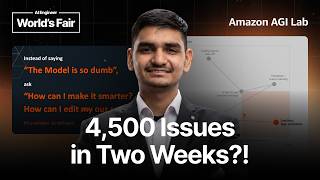
Aditya Khandelwal of Amazon AGI Lab argues that almost all published agent-setup advice assumes one developer and one repo, and breaks the moment a team shares production code — and that fixing it needs authority no individual contributor has. The talk gives both the diagnostic signals (people babysitting agents; "the model is dumb today" when the model didn't change; 40–50K tokens consumed on the first prompt against a ~20–25K baseline; 400–500 issues opened in two weeks) and the playbook his 10-person team used: a thin index instead of a monolithic instruction file, runbooks referenced from code comments, a 100-line cap on SKILL.md, one high-value "ship it" skill, and a nightly code gardener.
Two engineers from Anthropic's Applied AI team trace how the surface you build agents on changed three times in three years — Messages API, Agent SDK, managed agents — and what each step stopped making you hand-roll. The architecture argument is to decouple the agent loop ("the brain") from tool execution ("the hands"), which buys reliability, on-demand sandboxes and a measured 60% faster time-to-first-token at P50. Everything then rests on three primitives: agent, environment, session. Also covered: credential vaults that decrypt only at tool-execution time, self-hosted sandboxes in your own VPC, MCP tunnels for private-network MCP servers, and a warning that harness fixes go stale — the context-reset patches teams wrote for Sonnet 4.5 became pure overhead on Opus 4.5.
Nvidia's new 30B mixture-of-experts model activates only 3B parameters per token and is explicitly positioned for the execution layer of long-running agents rather than as a frontier reasoner. Because it interleaves Mamba-2 layers, serving it on vLLM needs flags a normal launch does not: the flashinfer Mamba backend, an FP16 Mamba state to halve memory, and stochastic rounding to stop that downgrade accumulating quantization error over long sequences. Roughly 75 GB VRAM as configured. Driven through Hermes Agent in autonomous mode with a judge model, it found an unhinted draft-clearance logic bug in a FastAPI/SQLite app within minutes. NeMo Switchyard shipped alongside it to route between an execution model and a frontier planner.
SpaceX AI's Grok Bot entered staged beta as a direct competitor to Hermes and OpenClaw, built around multiple named agents each with its own cloud computer rather than a single chief-of-staff assistant. Two techniques here transfer to any platform: recording a screen demonstration so the agent mints a reusable skill from it, and bootstrapping a new agent by having it query an existing agent's context instead of re-explaining your business. The verdict is a genuine split — zero setup and no crashes against no ability to swap the model, the harness or anything under the hood, which open-source Hermes and OpenClaw still allow.
Arjun Singh's team merges pull requests that are 99.9% agent-generated — and still human-reviews every one. His six lessons cover staying model- and harness-agnostic (they switched default harness twice in a week with no disruption), reaching one agent session from Slack, an app and GitHub, and getting projects off developer laptops into network-sandboxed cloud environments so an agent cannot find a production token it was never meant to have. The most reusable practice is the last: benchmark harnesses against your own repo using PRs that represent good work, because SWE-bench is all Python and your codebase may not be. Their numbers: 1.5B tokens last month, 3,300 Claude Code runs.
The opening hours of a free six-hour course are the clearest onboarding tour of the Claude desktop app we have transcribed, and the framing is worth having whatever you automate: everything sits on a four-rung ladder from prompt (you at the keyboard) to routine (a templated skill on a schedule, API call or webhook, running in the cloud without you). Covers the Home-vs-Code tab distinction most new users get wrong, the Customize tab where skills, connectors, plugins and memory live, the deny / always-allow / allow-once permission prompt, per-environment variables for API credentials, why cloud environments exist (reproducibility across machines), and sharing artifacts by public link to skip hosting entirely.
Dex — who coined "context engineering" — describes the planning discipline he puts in front of every agent build: product (problem plus the metric, with the announcement post written first), system architecture (services, flow, endpoints, tables), program design (file locations, types, method signatures, call stack, tests) and vertical slices (thin end-to-end first, because models default to building horizontally and leave nothing testable). The layer people skip is the third. His argument is context economics — a planning session at 43k tokens is where decisions are cheapest and the model sharpest. He also explains why his team abandoned the "never read the code" software factory after a bug took weeks to find in a codebase nobody had read for three months.
Meta has started releasing open weights again, and the first is Muse Glimmer — 30B distilled from Muse Spark, with a perception encoder for image input, a 128K window, and Apache 2.0 covering the whole package: BF16 weights, both quantized builds, the vision encoder and the Deep Flash drafter. Quantized it fits in roughly 24GB of VRAM. Fahd Mirza serves it on vLLM against a single A100, shows it consuming just under 70GB untuned and names turning down the KV cache as the lever for cutting that, then runs it through an image-to-web-app task and a deliberately trapped six-stage financial chain driven by a Hermes agent — which it completes with every dependent step correct, flagging a rounding-convention ambiguity rather than silently guessing. The honest caveat: it leads on MCP tool orchestration and long-context recall but sits behind Qwen on computer use and terminal work, and only middling on prompt-injection resistance.
IndyDevDan's argument is narrow and testable: a container gives your agents isolation and nothing else, while a durable sandbox VM gives them isolation plus scale plus autonomy. So instead of renting agents a corner of your laptop, you give each one an entire computer and move the whole software factory inside it. He runs five model configurations — Default, Frontier, all-DeepSeek, pure open-weights and Top Speed — against one prompt in five separate sandboxes, using a three-tier setup where an outside orchestrator kicks off in-sandbox orchestrators and then stops working. Top Speed finished a full development-lifecycle run in 14 minutes and about 2 million tokens; the open-weights run failed outright when Kimi K3 could not produce valid JSON, which is presented as the argument for best-of-N rather than against it.
The useful framing here is not a winner but a question: where do your agent's lessons live? Prime Agent keeps its own notebook — a continual harness it edits every 25 turns, with an immutable base prompt and snapshotted, reversible changes. Hermes, run this way, reads a vault that belongs to you, and every other agent you own reads the same one. Correct Prime Agent and Prime Agent gets smarter; correct the vault and the whole team does. The strongest safety point in the video comes from Prime Intellect themselves — an agent that learned to cheat at a game and then saved the cheating skill, which is exactly why a self-editing notebook has to stay readable and reversible. Part of the runtime promotes the creator's paid community; we've summarised the substance only.
Tech With Tim launches "AI Agent Builders", a free course hosted inside his community that applies his project-based teaching method to building agents. The video is an announcement rather than a tutorial — no setup steps, commands, configuration or code are shown.
Composio ran DeepSeek V4 Flash through four agent harnesses on the same 30 agentic tasks, changing nothing but the harness. The Pi-lineage harness passed the most tasks (17 of 30) against Claude Code and Codex at 16 and OpenCode at 14 — but each metric had a different winner: Claude Code was fastest at 123 seconds median per task while costing nearly 3× the cheapest option per successful task. The three-task spread is roughly ten percentage points from the harness alone, which is the size of gain people usually wait a model generation for. The proposed explanation is prompt size: Claude Code's system prompt was reportedly around 10,000 tokens tuned for Claude, and Anthropic have since cut it by about 80% with no reported performance loss.
Frank Coyle, who has taught computer science for over 30 years and now teaches at Berkeley, reads Anthropic's new Claude Certified Architect exam as an architecture syllabus rather than a certification — the six production scenarios encode what Anthropic has seen go wrong in the field. He names the anti-pattern before the fix in every case: calling the model once instead of looping on stop_reason; ignoring the token-limit stop reason and consuming a truncated answer as a complete one; loading one agent with every tool instead of one job and two tools; passing a critic agent the full reasoning so the agents converge into groupthink instead of just the claim and the evidence; letting subtask output flood the primary thread instead of forking context and merging back only the summary; and leaving interactive permission prompts on inside a CI pipeline. Concrete numbers along the way: $99 for individuals once every six months, a five-domain split weighted 27% agentic architecture and 20% Claude Code configuration, a three-level CLAUDE.md hierarchy, a 150,000-token compaction threshold, and 50% off via batch processing if the job can wait 24 hours.
Prime Intellect's MIT-licensed Prime Agent replaces the usual tool-call loop with a persistent IPython kernel: the model treats its own context as a variable and writes Python to process large files instead of reading them into the prompt, with sub-agents spawned as ordinary function calls. Its harness — prompts, memories, skills, sub-agent specs — is editable state that a /refine pass updates from your corrections, guarded by an immutable base prompt and rollback snapshots. It logs in with a Claude, ChatGPT or Copilot subscription you already pay for, or 20+ API providers, or local models. Two things to know before trying it: the headline ARC-AGI 3 result is self-reported, and the project states plainly that it is not a security sandbox — it runs model-generated Python and shell with your user permissions.
Contributors from AWS, Cursor, GitHub, Microsoft, OpenAI and Vercel have jointly published Agent Plugins, an open format for packaging agent extensions. At its simplest a plugin is a folder with a plugin.json manifest at the root; the first release covers agent skills and MCP servers placed in standard locations, so one package can be supported across products instead of repackaged per platform. The spec deliberately standardises packaging and discovery only — not marketplaces, permissions or runtimes — so the install-time trust question is unchanged.
An unrehearsed build-with-me session from an empty folder, with Claude Code as an orchestrator over free local tools — Whisper for word-level transcription, FFmpeg for the cuts — plus Hyperframes for animation and Higgsfield MCP for generated B-roll. The architectural move is making the transcript the timeline so every edit decision becomes a text operation. The valuable part is the failures: Claude shipped 85 passing unit tests over a cut engine that was silently wrong, and only real footage exposed a hard-coded −35 dB silence threshold and a transcript-versus-audio misconception about where dead air lives.
A screen tour of a custom Hermes dashboard combining chat, a voice agent, a Kanban task board, scheduled jobs and one-click model switching, with an Obsidian vault as the shared memory layer every agent reads from. It is a feature walkthrough rather than a build guide — no installation commands or configuration are shown, and it resolves into an offer to download the assembled system from the creator's paid community.
A 60-minute beginner-to-working course taught by a former Amazon and Microsoft engineer. It covers the native install, why an IDE beats both the desktop app and a bare terminal, and the four permission modes — plan, accept edits, auto, and bypass — with a clear line drawn at auto mode's AI safety review of bash commands versus bypass running unrestricted. The centrepiece is a worked example: screenshot an existing web app, have Claude plan a clone in plan mode, refine the plan before approving it, then hand off to the /goal evaluator loop that regenerates until a stated success condition is met. Later sections cover CLAUDE.md and agents.md, git version control, connecting MCP servers and CLI tools, and deployment.
A screen tour of using Qwen 3.8 Max as the model behind an agentic operating system, with Hermes (or Claude Code) as the harness that does the work and a workflow UI on top — plus memory auto-saved to an Obsidian vault, a Hunter-API lead-outreach workflow, and a scheduled news-digest task. Goldie's parameter, context-window and benchmark claims for the model are his own and are not independently verified here; the video shows no install steps or commands, and points viewers to his paid community for a copy of the setup.
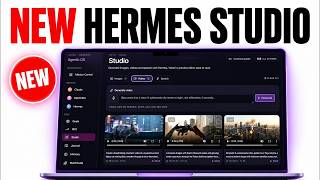
A screen walkthrough of the Hermes "Herald" release. The headline change is conversational voice: the agent speaks while it is still thinking, and talking over it interrupts and redirects mid-sentence rather than queueing a new prompt. Alongside it are a wake word for hands-free start, an agent-to-agent (A2A) protocol plugin that lets Hermes discover, call, and be driven by other A2A-compatible agents, a grounded-citation research skill, sandboxed artifact previews on the desktop app, mid-turn correction that removes the stop-and-re-explain loop, and first token in 0.9 seconds against 4.3 seconds previously.
IndyDevDan rebuilds his "super simple software factory" — an open-source system of AI developer workflows that chain specialised agents together with plain Python between each phase. The central claim is that agents plus code beats agents alone: code owns validation, gate checks, and type enforcement, so agents never burn context on work a script does for free. He runs three workflows of increasing size, opens the YAML config that assigns a different model, prompt, and harness to each agent role, and packages the whole system as a skill that installs into any codebase.
Nate B Jones lays out a five-level ladder for people building on AI, from level 1 — in love with a single idea and knocked sideways by every frontier-lab release — up to level 5, where you can forecast what AI will make possible in your specific domain six to twelve months out and build for that capability before it lands. His argument is that lab launches only feel like an extinction event near the bottom of the ladder; higher up they read as tailwinds, because depth in a narrow problem space is the one thing a lab cannot out-research.
Buzz looks like Slack — channels, DMs, threads, emoji reactions — but the members in the sidebar are AI agents rather than people, each with its own identity and a record of what it did. FuturMinds installs it, wires it to existing Claude Code and Codex sign-ins, and builds a three-agent content team (lead, researcher, writer) that turns a one-sentence brief into a finished draft. The verdict at the end is deliberately unhyped: promising, but not a Slack replacement yet.
A short explainer on the standard pattern for agent long-term memory: convert your data into embeddings, store them in a vector database, and give the agent a search tool so it retrieves only the relevant pieces for the task at hand. Tech With Tim names this as RAG and frames it as the answer to a specific problem — the context window is already full of the current conversation, so documents and long-term facts have to live somewhere the agent can query on demand.
Julian Goldie argues that the limiting factor for most agent setups is not the model but the system around it, and describes his "Agent OS" as three layers wrapped around Hermes: the brain, mission control, and an Obsidian-based memory vault the agents read before working and write to afterwards. No commands or setup steps are shown — the build itself is distributed to members of his paid community — so we have summarised the conceptual framing only.
Fahd Mirza joins three pieces — Hermes agent, an Obsidian vault, and a local model served by Ollama — into a note-taking assistant that runs entirely on his own Ubuntu machine with no API key and no cloud calls. The agent creates notes, searches the vault, reads results back, and links notes together using Obsidian's wiki-link syntax. In the last test it reaches for the Obsidian skill unprompted, without being told the skill name or the vault path.
An agent never holds a skill in its head. It reads only the skill's name and description on each turn, and pulls in the body of the file once a job matches — which makes the description, not the instructions, the thing that decides whether a skill ever fires. Nate B Jones uses that mechanism to explain the two failure modes behind skills that install cleanly and change nothing: descriptions too vague to trigger, and descriptions so broad the skill surfaces on unrelated jobs and eats context the real work needed. He also makes the case for treating downloaded skills as untrusted input, and for auditing conflicts once you pass roughly twenty of them.
A 30-second correction to a common intuition: the model itself stores nothing between calls. An agent stays coherent across many steps only because the harness feeds the entire conversation back into the context window on every single turn — re-reading everything that happened, each time it runs. That is the mechanical reason long agent sessions fill their context, and why memory files and summarisation exist at all.
Julian Goldie lays out a five-layer way of organising a self-hosted agent setup so a new model release does not mean rebuilding your workflow: one dashboard with every agent wired in, a shared memory vault (Obsidian, which can run fully locally), a router that sends each job to whichever model suits it, parallel agents worked off a Kanban board by a single orchestrating agent, and a loop feeding finished work back into memory. No code or terminal work is shown — the stated method is to describe the dashboard to a coding agent and have it build the thing. A large share of the runtime promotes the creator's paid package.
NemoClaw v0.0.97 — provider switching no longer strands you mid-change
2026-07-31 · Release note · NemoClaw
NemoClaw cut v0.0.97 on July 29, grouping the 43 PRs merged since v0.0.96. The headline is a two-part provider-switching fix. nemoclaw inference set was failing outright when a direct compatible provider was absent or its endpoint had changed. It now inspects the provider binding before route selection, creates and verifies an absent provider before the first route attempt, and commits a verified update for an existing provider only after route selection — so a failure restores the prior selection instead of leaving you between two states. A follow-up stops NemoClaw verifying an existing provider's old endpoint, and makes it refuse an endpoint replacement it cannot roll back, since the previous value is redacted and could not be restored. Full detail in the July 29 changelog; see the NemoClaw switching-providers guide.
Kilo Code v7.4.17 — prompt navigator, docked terminals, and console URLs that open
2026-07-31 · Release note · Kilo Code
Kilo Code shipped v7.4.17 on July 29, a navigation-and-terminals release. It adds a prompt navigator rail to the chat transcript, and Agent Manager terminals can now run in the VS Code terminal or in an embedded side panel with a full tab strip. For headless and VPS users the practical fix is kilo console, which now includes basic-auth credentials in the Local and Network Console URLs it prints — previously those URLs could not actually be opened on a headless host. Also fixed: a checkpoint that cannot be fully restored no longer takes your work with it, the phantom "Turn interrupted" warning is gone, and the VS Code backend stopped starting native file watchers for every Agent Manager worktree. Upstream opencode v1.17.5 → v1.17.9 is folded in. See the July 29 changelog and our Kilo Code setup guide.
freeCodeCamp has released a full-length, free course on building production-ready multi-agent systems with LangChain and LangGraph. It runs in seven phases — from what separates an agent from a plain LLM app, through async Python and Pydantic validation, LangGraph state graphs, memory, RAG and human-in-the-loop controls, to Dockerising the result and deploying it on AWS and Render. It closes with three end-to-end projects, including a multi-agent trip planner on Groq and PostgreSQL.
Tech With Tim corrects a common misconception in one minute: the model never performs an action itself. It predicts text, so when it wants a tool it emits a structured, code-like message naming that tool. The software running the model executes the real tool and hands the result back. That handoff between model and harness is the whole mechanism behind AI agents at scale.
Julian Goldie tours a three-layer "agent operating system" built around Hermes: the brain (Hermes plus swappable models, including free ones), mission control (one dashboard with chat, voice and agent teams instead of the terminal), and a memory vault — a plain-text Obsidian folder agents read before working and write to afterwards. He argues the memory layer is the one people skip and the reason agents feel generic. It is a tour of his own paid-community build, with no commands or config shown.
Buzz is a self-hosted, open-source collaboration platform from Block that puts humans and agents in the same Slack-style channels. Agents are @mentioned like colleagues, run on whichever harness you already pay for — Codex, Claude Code or Goose — and talk to each other through the Agent Client Protocol, so a Codex agent and a Claude Code agent can share one thread. Per-agent permissions gate expensive models, and a compute tab lets community members run agents on each other's hardware.
Nate B Jones instrumented his own usage and found 3.77 billion tokens moving through his Codex workspace in a single working day — 96% of it reused input nobody typed, re-sent on every turn. The fixes are organised in three levels: habits that cost nothing (edit mistakes instead of correcting them, start a clean task when the job changes, carry the artifact not the argument), a skill that automates most of them, and a local proxy that shrinks the request before it leaves your machine. Tool definitions alone can burn ~55,000 tokens before a request does any work.
Herdr is a Rust terminal multiplexer built for parallel coding agents. Where tmux only splits panes, Herdr reads what is running inside each one and marks it blocked, working, done or idle — so with four agents in flight you go to the one waiting on a decision instead of checking every window. Fahd Mirza runs OpenCode and Hermes side by side, showing the difference between hook-reported state and screen-scraped inference, plus detach/reattach over SSH and a socket API agents can drive themselves.
FuturMinds wires Hermes Agent to four Apify actors and an Airtable base to research local businesses — Google profile, website screenshot, live Facebook ads, social activity — then score them and draft an opener. The transferable pattern is the last third: prove the workflow interactively, tell Hermes to save it as a reusable skill parameterised by niche and city, then attach a cron schedule. Scraping and outreach carry legal obligations the video doesn't cover.
Coverage of Moonshot's Kimi K3 open-weights release and pointing Hermes at a hosted copy rather than self-hosting a ~1.4 TB download. Mostly a pitch for the presenter's paid bundle, but it collects some useful rough edges — K3 always runs a full reasoning pass, a flagged hallucination rate, and a Hermes side-model setting that silently degrades image reading and chat compaction if never configured — plus a rundown of what shipped in Hermes 0.19 "Quicksilver".
A tour of five Hermes Agent workflows driven from a dashboard rather than a terminal: a scheduled news radar, a lead-list builder that drafts outreach for manual approval, a video pipeline built on Remotion and Hyperframes, an SEO pipeline reading Google Search Console data, and a "loop engineer" pairing a builder model with an adversarial judge that re-runs the work until it meets a stated definition of done. The dashboard is the presenter's paid bundle, so treat it as a demo of the patterns rather than an install guide.
Tech With Tim pushes back on descriptions of agents as little brains that think and reason, arguing that framing is why the topic feels like hype rather than something practical. His one-sentence version: an AI agent is a language model that can use tools, running in a loop until it finishes a job. Everything else is scaffolding around those three parts.
Inclusion AI (Ant Group) released an open-weight diffusion model for agent workloads. Instead of predicting one token at a time, it drafts a block and refines it — and Levenshtein-style delete and insert moves let it correct a wrong chunk mid-generation rather than plowing ahead with the mistake baked in. Roughly 703 tokens/second on BFCL tool-use, around 100B parameters, weights on Hugging Face.
T3 Code's nightly build replaces its project-grouped sidebar tree with a flat, inbox-style list: active threads render as rich cards at the top, finished work collapses into a "Settled" section. Auto-settle clears threads after N days (default 3), merged and closed PRs settle themselves, and new activity unsettles automatically. Enable it under Settings → Beta — it's off by default and needs an up-to-date server.
A fast tour of five ChatGPT capabilities aimed at desk work: a desktop app that acts on local PC files, a Work toggle that points it at a whole project folder, plugins that connect accounts like Gmail, recurring scheduled tasks, and approval-gated desktop file organisation. Note this one is a paid OpenAI partnership — the feature list is concrete, but the framing is promotional.
Nate B Jones's team resolved 51 of 52 support issues in a week with AI — then decided a 98% resolution rate was the wrong thing to be proud of. Instead of answering the same tickets faster, they root-caused the biggest category and changed the access path so the tickets stopped arriving. Volume fell to 19 the next week. A full playbook: write the process down, group cases by root cause not subject line, run in draft mode, and keep humans on anything touching access or money.
A Korean open-weight model aimed at real work: 250B parameters with only 15B activated, up to 1M tokens of context. It stacks three lightweight linear attention layers per traditional attention layer and drops positional encoding entirely, cutting the KV cache to roughly a quarter the size. Fahd Mirza runs it through an enterprise AWS cost analysis (strong), a zero-dependency interactive coding task (clean pass), and a multilingual test (weak) — plus the license clause that forces derivative models to be named "Solar".
Jack Dorsey's Block launched Buzz — think Slack and GitHub merged, but with AI agents as actual team members. It's open source (Apache 2.0), free, and built on the Nostr protocol. Each agent gets its own cryptographic identity, permissions, and a full signed audit trail, and agents run locally through your existing Claude Code or Codex install, so there's no separate API bill. This deep dive covers the full setup, the identity model, the Git side, and how to self-host.
OpenAI rolled out a new ChatGPT desktop app that merges Chat, a new "Work" agent, and Codex into one place. Free to try on Mac and Windows, its computer-use feature can click, type, move files, and browse in the background — one-time or scheduled — gated by a per-site permission system and powered by the new GPT-5.6 model family (Sol, Terra, Luna).
"Don't paste sensitive info into AI" stops too soon — the work still needs doing. Nate B Jones walks through Airlock, a tool he built to strip PII and confidential data from a document before handing it to a frontier model, while keeping the context the task actually needs. The core discipline: start with the job, not the file, and decide what the model needs to see before you decide what to remove.
The biggest misconception about Claude Code is that it's only for developers — it's a general AI agent that happens to write code. David DeWinter (partnering with Anthropic) walks a non-coder through building a working sales-pipeline app from a spreadsheet inside VS Code, using plan mode, permission modes, @-file references, and slash commands like /rewind — plus three reasons to reach for Claude Code over Claude Cowork, and one big red flag.
Fahd Mirza stress-tests Ling 3.0 Flash — Inclusion AI / Ant Group's 124B mixture-of-experts model with just ~5.1B active parameters, free via OpenRouter — as a coding agent inside Hermes. On paper it punches above its active-parameter count; in a real four-bug debugging task it got stuck in loops, and a creative canvas prompt produced a weak render. A candid look at how these efficient models behave in real agentic work.
Tech With Tim builds an entire newsletter operation — research, drafting, scheduling, social posts, and analytics — run by a team of collaborating AI agents with zero employees, coordinated from Telegram via 24/7 scheduled tasks. He walks through the agent-team setup and closes with a cost comparison against hiring a contractor. (The platform used, Axiom Work, sponsored the video.)
Software engineer Tech With Tim argues that most AI-agent setups shared online have serious security holes, and walks through fixing them end to end. He frames three attack surfaces — the box, the prompt, and the tools — then shows every command to remove a VPS from the public internet: a Tailscale mesh VPN, disabled root and password login, a dedicated sudo user, and a UFW firewall.
Hermes Agent v0.19, the "Quicksilver" release, is a speed-and-reliability update: cold-start drops from 4.3s to 0.9s (~80% faster), background jobs and replies are persisted to a database so they survive a crash, and one gateway can route channels to separate agent profiles — each with its own model, memory, skills, and secrets, plus a second-AI approval gate and secrets redaction.
In this short OpenAI segment, Wonderful's Barak Kaufman describes a shift now underway in large organizations: from automating individual manual tasks toward using longer-horizon, multi-agent, multi-modal systems to rethink how work itself is done. His framing: the enterprises moving fastest treat agents as an operating-model change, not an infrastructure project.
Kevin Stratvert demonstrates a simple, practical ChatGPT use case: photograph a fragile item, then ask for step-by-step instructions to pack and ship it safely — materials, wrap, box size, and a shake test. ChatGPT analyzes the object's shape from the photo and returns a complete packing guide.
Anya Kubow takes a habit-tracker app from a single sentence to a deployed full-stack product inside TRAE IDE, spending the first stretch on planning rather than code. The walkthrough covers generating a product requirements document from a plain-English prompt, trimming it to an MVP, building a custom brand-aware agent, then running two agents in parallel — one restyling the front end while the other adds a Node/PostgreSQL back end — before deploying to Vercel. freeCodeCamp discloses that TRAE funded the course with a grant.
Julian Goldie swaps the model behind Hermes over to Kimi K3 (Moonshot) and walks through what changes: hermes model opens a provider picker, /learn turns a linked guide into a locally stored skill the agent can reuse, and a shared memory layer means context written in the Kimi CLI is visible in the Hermes agent and vice versa. He also bridges Kimi K3 to Blender over MCP. The video's benchmark placements are stated without a linked source, so we've flagged what we could not verify.
Google quietly refreshed the Gemma 4 weights on Hugging Face on 2026-07-15 — same version number, new files — and the change that matters most for agents is a tool-calling fix, with Google's own testing cited at over 10% accuracy gain on one use case. The refresh also closes an attention-size mismatch (26 layers at one size, 4 at a larger one) that had been crashing and stalling local runs, adds up to 70% faster prompt processing and 31% faster time-to-first-token, and supports images over 2.5× larger for OCR work. The walkthrough points Hermes Agent at a local Gemma 4 via the dashboard's Manage → Add profiles flow, using Ollama or LM Studio.
OpenAI has reorganised ChatGPT around three surfaces inside one connected desktop app: Chat for questions, Codex for development, and a new agent called ChatGPT Work that takes on long-running projects and connects to apps you already use. The same structure is coming to web and mobile so workflows stay in sync, and a cloud browser ships with plugins for more than 100 apps — with computer use as the fallback when no native plugin exists. A one-minute rundown rather than a walkthrough; check OpenAI's release notes for actual plan availability.
A creator runs 23 side-by-side game and app builds across Qwen 3.8, GPT 5.6 Soul, Fable 5, and Kimi K3. Qwen 3.8 — a 2.4-trillion-parameter model heading to open weights — wins on graphics and creativity but trips on controls and physics. Fable 5 stays the reviewer's overall favorite, with Kimi K3 a close second on UI polish and physics.
A short argument that the limiting factor on frontier AI labs is no longer capability or even compute — it's regulatory permission, to the point where Washington can delay a flagship release with a phone call. In that environment, political alignment stops being corporate social responsibility and becomes basic infrastructure for shipping a model.
OpenAI's first piece of hardware is a small macro pad called Codex Micro, built with keyboard maker Work Louder. Six backlit keys each map to a running Codex agent and glow with its live status, a dial adjusts reasoning effort, and a joystick fires preset workflows. The video frames it less as a must-buy than as a signal that OpenAI expects people to supervise several agents at once.
ChatGPT's search previously looked only inside the conversation you had open. Unified search now queries your entire account — every chat, project, uploaded file and generated image — with filters to narrow to one type, on web, iPhone and Android. It becomes most useful paired with Projects, which scope files, instructions, memory and chats to a single topic or client.
Four flagship models landed within weeks of each other in mid-2026 — OpenAI's GPT-5.6 Soul, Anthropic's Fable 5, xAI's Grok 4.5, and Z.ai's open-weight GLM 5.2. This rundown covers what each is tuned for, where to access it, and the trade-offs. The honest verdict: none wins outright — pick by task, and always check the output yourself.
Nate B Jones handed Codex (GPT-5.6) and Fable 5 the same open-ended job: inspect his files and Slack, then pick their own problem to automate and build a solution. Codex finished cleanly but chose a safe, bounded problem; Fable found a more strategic, higher-leverage one — but was slower and prompt-heavy. His takeaway: run both in parallel and let each do what it's best at.
Nate B Jones argues the thing holding back Fable 5 and GPT-5.6 usually isn't the prompt — it's the bloated "harness" of instructions, skills, memory, and permissions that accumulates one correction at a time. His audit turned up 66 skills and 172 instruction files. Six principles for making that harness visible and cleaning it, plus how Fable 5 and GPT-5.6 fail differently when the setup is overloaded.
Alex Finn switches his Hermes Agent default from Claude Opus to GPT-5.6 "Soul," calling it smarter, far cheaper (a subscription instead of ~$200/day of Opus API), and better at computer use. He walks through setting the model in the Hermes dashboard, why he runs reasoning at medium, and three use cases: a home AI lab, an autonomous Unity game studio, and website price-drop monitoring.
NemoClaw v0.0.82 — snapshot clones get their own dashboard port
2026-07-14 · Release note · NemoClaw
NemoClaw tagged v0.0.82, rolling up the user-facing fixes merged since v0.0.81. The headline fix: snapshot clones now get their own dashboard port. Previously snapshot restore --to <dst> copied the source's registry entry, so a clone inherited the source's dashboardPort — its dashboard-url pointed at the source and every rebuild was rejected. The clone now gets a destination-owned port allocated at registration. Onboarding an OpenAI-Chat-Completions agent (like Deep Agents) against an Anthropic-only endpoint now prints a concrete next step instead of a bare failure, and an ssh mux-forward fix stops a healthy sandbox being deleted after a false forward-timeout on hosts using ControlMaster multiplexing. Details in the July 14 changelog; see the NemoClaw switching-providers guide.
Kilo Code's new open-source CLI brings its agentic coding workflow to the terminal: pick from 500+ models with a slash command, plan in one model and build in a cheaper one, and lean on an auto-router that scores each task against Kilo's own benchmark. It also ships built-in agent modes, live per-session cost tracking in dollars and tokens, remote cloud sessions, and one-command local review and PR creation.
This hour-long tutorial walks non-technical users through the Codex desktop "super app" — the window that holds both the ChatGPT chat and the Codex build environment. It covers plan mode, access levels and effort/speed dials, running locally or in the cloud, forking runs into git branches, and connecting skills like Gmail so Codex can build websites and run scheduled automations in the background.
A short take from Nate B Jones on why — despite eye-popping token spend and strong open challengers like GLM 5.2 — there's still no tipping point away from Anthropic and OpenAI, both of which keep growing revenue fast. Analysis and perspective, not a setup or benchmark walkthrough.
Nick Saraev walks through the AI-agent workflow his business actually runs: a shared human-and-AI workspace in Linear where tasks tagged "AI ready" fire a webhook to an agent. The agent — powered by Fable 5 — consults a knowledge base for context and preferences, works autonomously, and waits for approval before any outward-facing action.
Fahd Mirza installs OpenLumara — a from-scratch Python agent framework for local models — and connects it to Ollama. Its pitch against OpenClaw and Hermes is a tiny core with everything else (memory, shell, web) as toggleable modules, so a disabled module means zero tokens and zero attack surface.
Nate B Jones argues the right way to choose between GPT-5.6 and Fable 5 isn't benchmark scores but your own working style. He explains why he reaches for GPT-5.6 (plus Codex) for his high-intent, verbose prompting, while acknowledging Fable 5 is the stronger generalist for high-level, ambiguous work.
Julian Goldie's avatar demonstrates running OpenAI's Codex on free model providers by editing Codex's own model-provider setting to point at a free API (Omniroot, or HY3) — leaving your normal OpenAI login untouched. The concept is wrapped in a promoted "Agent OS," and the video is largely a pitch for a paid community.
IndyDevDan (Dan Eisler) argues that "loop engineering" is a hype-filled rebrand of the software development life cycle, and that the real unit of agentic work is the AI developer workflow — the classic plan → build → test → review → ship pipeline, now executed by a mix of engineers, agents, and code. He builds from the smallest atom (prompt an agent, review the result) up to a full "software factory," and argues engineers should work the meta layer: "build the system that builds the system." Conceptual architecture talk, not a hands-on tutorial.
Hermes Cloud lets you deploy an always-on agent that runs 24/7 on hosted portal servers instead of your own machine — you name it, pick from 200+ models, and it launches in a sandboxed container in about a minute. It solves the "closed-lid problem" (local agents stop when you close your laptop), bills only while the agent is actively working, and stays reachable across Telegram, Discord, and other channels from one shared memory.
Nate Herk uses Claude Code as the orchestrator and Clay as the data source to run cold outbound from a single prompt. A Clay plugin (installed from the Claude Code terminal) exposes Clay's B2B data as MCP actions, and a /goal prompt then sources 50 HVAC leads, enriches them with verified emails and pain points, and writes personalized subject lines and bodies — fanning out sub-agents that self-verify before delivering a ready-to-send CSV you import back into a Clay campaign.
Rather than benchmarking, Nick Saraev lets GPT-5.6 Soul run a fully autonomous "product ad engine." Driven from Codex CLI and wired to the Higsfield MCP (image + video models) plus Netlify, the model invents 80+ physical products, generates stills with GPT Image 2, animates ad videos, and auto-publishes sites — with a self-QA loop and parallel sub-agents. The lesson: don't hand the model a one-to-one prompt; tell it to build the infrastructure to generate thousands and run itself, then let human taste pick winners.
Nate Herk's beginner course reframes Claude Code for non-coders: it's a harness that pairs an AI model (Opus, Sonnet, Haiku, Fable) with your context and judgment, distinct from Claude chat and Claude Cowork. He then walks through six career-proofing AI skills — being the AI person, taste, context engineering, iteration speed, and building an always-on Jarvis — including when a task needs an AI agent versus a deterministic workflow.
Julian Goldie runs GPT-5.6 through the updated Codex — now folded into the ChatGPT app rather than a separate product. In one session he redesigns a website from an existing site, triggers background computer use that publishes a Skool post on his behalf, edits a video via a Descript plugin, installs an agent from GitHub, and tries the new "pet" task tracker and adjustable effort levels.
Nate B Jones lays out a four-factor test — size, independence, separation of concerns, and checkability — for deciding whether a task needs a chat, one agent, a team of agents, or no AI at all. He grounds it in Stanford's repeated-sampling study and Anthropic's multi-agent research, then shows a harness that cut Fable 5 costs ~10x by letting Fable plan while cheap worker agents execute.
Nate Herk drives GPT-5.6 Sol (via Codex) against Fable 5 (via Claude Code) on identical build prompts and stateless API tasks. Fable wins on raw build quality but costs up to ~20x more per run; Sol is far cheaper, more token-efficient, and stronger on quick one-offs. His verdict: Fable is the manager, Sol is the worker — and the best setup is Fable orchestrating cheaper Sol agents.
Nate Herk gave GPT-5.6 Soul one prompt on Codex "Ultra" and it produced a full narrated, avatar-led video end to end — research, scripting in his voice, ElevenLabs/HeyGen/Hyperframes, and frame-by-frame self-checks. He also digs into the real token cost: Ultra spun up nine sub-agents and burned ~450M tokens (~$300), which he argues was over-delegation — the same prompt on "high" would likely match the result at half the cost.
Kilo Code introduces Kilo for GitHub — an AI coding agent you @-mention inside GitHub issues and pull requests. It reads the surrounding thread, diff, and codebase to answer questions, diagnose bugs, and implement real changes without leaving GitHub.
A multi-agent "org chart" where Claude Fable 5 only plans, reviews, and settles disputes while four cheaper model families do all the coding. The build shipped a production site in about two hours for roughly $8 (versus an estimated $85–105 on Fable alone), and independent checker agents caught four escalating failures — a quote hallucination, two worker cheats, and a CSS bug written by Fable itself — with zero human correction.
Alex Finn distills four months with Hermes Agent into nine practical lessons — which model to run (Opus vs ChatGPT vs GLM 5.2), why to run 2+ agents that repair each other, when to stop over-isolating accounts, the best platforms (desktop, Telegram, iMessage), pruning cron jobs to fix a slow agent, using Tailscale to run a whole device fleet, and a daily reverse-prompt interview to find new automations.
The model isn't the moat — the process is. Nate Herk extracts Fable 5's working discipline into a reusable "Fable mode" skill file built on five gates (scoping, evidence, attacking, verifying, reporting), then pairs it with a cost/intelligence/taste routing table so cheaper models like Opus 4.8 reason with the same rigor at a fraction of the cost.
Nick Saraev renders bulky Claude Code context as a single tiny-but-legible image so image billing (fixed by pixel dimensions) beats text-token billing. Measured savings: about 33% on a general prompt and up to ~59% on a large retrieval query, with no measured loss in recall — an arbitrage of current pricing he expects to be patched.
Fahd Mirza feeds a single screenshot of a live fantasy-sports site into Hermes Agent and asks it to build and run an exact local clone in one prompt — using Sakana's new Fugu Ultra orchestration model, which routes each task across a pool of frontier models. A deliberately skeptical, one-shot test of whether screenshot-to-app orchestration holds up outside the benchmarks.
freeCodeCamp's beginner course climbs from LLM fundamentals — tokens, temperature, context windows, and prompting — up to building four agents (Zippy the orchestrator plus Savvy, Meshy, and Cody) and a case-study dissection of OpenClaw's architecture, agent loop, memory, testing, monitoring, and security. This page distills the reusable engineering concepts.
Alex Finn walks through seven new features in the latest Hermes Agent update — mixture-of-agents orchestration (/ma) that fans a prompt out to ChatGPT and DeepSeek via OpenRouter and synthesizes one answer, /learn that turns any URL, tweet, or completed task into a reusable skill, a /journey memory graph, cheaper background self-improvement, and git-controlled vibe coding with diffs, commits, and PRs. He closes by recommending a dedicated Hermes profile for Fable 5, reserved for complex builds rather than daily driving.
IndyDevDan walks through CMUX, a scriptable terminal multiplexer that gives agents programmatic control over multiple coding-agent sessions at once (Claude Code, Codex, Pi). He frames it around three orchestration problems — no programmatic access, no visibility to improve agents, and slow team startup — then demos a three-tier orchestrator → lead → worker pattern with a flat channel where any agent can prompt any agent. CMUX is Mac-only; T-mux is the cross-platform alternative.
Fahd Mirza installs and tests Headroom, a local, Apache-licensed proxy that sits between your agent and the model and compresses everything the agent reads — file dumps, tool outputs, logs — before it lands in context. He wires it to a Hermes agent on a local Ollama model, runs a bug-fix task, and shows the context window holding at ~40K instead of blowing past it. Compression is reversible: the model pulls the original text back when it actually needs it.
Julian Goldie shows how to run the open-source Codex CLI without an OpenAI subscription by pointing it at OmniRoute — a local gateway that routes requests across 93 providers, 11 of them permanently free. It's the same real Codex CLI; only the backend changes. Auto-fallback silently hops to the next provider when a free one hits its rate limit, so a build keeps going instead of breaking mid-task.
NVIDIA and KAIST researchers released SpatialClaw, a training-free spatial-reasoning agent that hands a vision-language model a persistent Python kernel and lets it write, run, and inspect code one cell at a time — instead of committing to a single up-front program or a rigid, one-tool-at-a-time JSON interface. Fahd Mirza walks through the five-stage agent loop, the self-correction that lets it recover from its own mistakes mid-run, and benchmark results where it beats the previous best spatial agent by 11.2 points with no task-specific training. His honest caveat: it's a research-cluster project, not a single-GPU download.
Julian Goldie demonstrates the open-source Hyperframes skill — now with keyframe and arc-motion support, so an agent can watch its own generated motion and self-correct it — paired with a Hermes-based video agent that researches a topic, writes a script, generates B-roll and an avatar presenter, and assembles a finished video from a single prompt. Much of the video is a walkthrough of his paid community setup rather than a reproducible build, so treat it as a product tour.
Most agent demos stop at drafting emails. Nate B Jones builds one reusable nine-part "agent skeleton" — context pack, ingest, chunk, normalize, store, retrieve, cite, export, and a hard human gate — then applies the exact same structure to insurance appeals and tax prep. A context-engineering framework for high-trust paperwork where the agent organizes the mess but never submits, pays, or signs.
Julian Goldie answers community setup questions for an agent operating system built on Hermes: carrying your existing Claude skill markdown files over to Hermes, the five things to configure first, using Hermes' primary/auxiliary model fallback with backup keys, reaching the system from your phone via Tailscale, and hosting agent-generated sites on Netlify.
On June 30, 2026, X launched a hosted MCP (Model Context Protocol) server at api.x.com/mcp that gives AI agents a live, read-only window into X through your own account's OAuth permissions — no custom server to build, no API to hand-wire. It exposes 200+ X API tools (search posts, look up users, read conversations, spot trends, pull bookmarks) and works with clients like Claude Desktop, Cursor, VS Code, and Grok.
Tech With Tim deploys both OpenClaw and Hermes Agent on real VPS instances and runs identical jobs through each. The verdict: Hermes wins as a single-user daily driver — its “curator” writes and refines skills automatically and its memory is faster and deeper — while OpenClaw's edge is its 5,400-skill catalog and easier multi-gateway routing for customer-facing, multi-channel deployments.
Hermes Agent V0.18 — the “Judgement” release — centers on verification: a self-judging /goal loop where a separate judge scores each round against your definition of done, and proof-of-work that marks coding tasks complete only after running the project’s own checks. It also promotes mixture-of-agents (fusing multiple models into one answer) to a first-class mode and adds /learn, /journey, and background sub-agent fan-out.
Analyst Nate B Jones argues the fastest way to make an AI agent dangerous is to let everyone use it while no one owns it. Once an agent can read files, draft messages, or change code, a specific person must be operationally accountable — not just on an org chart. A short, pointed case for assigning a clear owner before you widen agent access.
A full Hermes agent walkthrough — a two-minute install, adding skills from GitHub, wiring up a Telegram gateway with hermes gateway setup, scheduling tasks, and configuring memory, profiles, and per-task model routing. Highlights what sets Hermes apart from OpenClaw: preloaded skills, self-healing when a skill errors, and broad built-in provider support.
Bart Slodyczka runs the new open-source Ornith 1.0 9B dense model locally on a 16GB Mac mini via LM Studio and PyAgent, asking it to build a tower-defense game. The 9B produced broken code (undeclared functions, broken tool calls, debug loops) while the 35B one-shotted a playable game — an honest look at where small local coding models still fall short.
Analysis, not a how-to: Nate B Jones argues OpenAI's restricted, government-reviewed GPT-5.6 rollout — alongside Claude Tag in Slack, Apple's context-connected Siri, GLM 5.2, and OpenAI's Codex adoption study — all point to the same shift. As frontier intelligence slows and gets cheaper, the next advantage is context, not raw model capability.
OpenAI quietly replaced GPT-5.3 Instant with GPT-5.5 Instant as the default ChatGPT model — no launch event. It cuts hallucinated claims by 52.5% on high-stakes prompts, runs roughly 3x faster on quick tasks, and returns about 30% shorter responses. Meaningful gains inside agent loops, where every extra token adds latency and cost. Best used as a fast/light layer alongside a heavier frontier model for complex builds.
Allie K. Miller describes "AI watchdog" agents — a persona that sits in on every conversation as a witness rather than a contributor, "like a McKinsey consultant in the corner keeping tally." It doesn't build; it notices patterns, counts recurring problems, and flags when two teams are unknowingly doing the same work. A short, conceptual framing for non-builder agents on a team.
OpenAI put Codex, its autonomous coding agent, inside the ChatGPT mobile app on iOS and Android — on every plan including free. Julian Goldie walks through the new mobile workflow: your phone as a remote control for jobs running on your computer, push notifications, high-level "goals", a parallel side chat, and file previews with inline comments for reviewing code before you approve it.
Fahd Mirza wires up OpenJarvis — Stanford's local-first AI agent framework from their "Intelligence per Watt" research — to Ollama on a single-GPU box. The walkthrough covers the one-line install, seven built-in presets, an Open Claw–style doctor health check, and a benchmark that reports average watts and joules per token alongside speed, all at $0 cost because it runs locally.
Most AI-productive people juggle five or six tools and become the human "hallway" carrying work between them. Nate B Jones's answer is Open Engine: put the work in a shared queue (Linear) plus a set of skills, so a ticket — not a chat box — becomes the place any agent or teammate can claim, work, and hand off a task with full state attached.
AICodeKing tests Ornith, Deep Reinforce's family of open agentic coding models (9B, 35B, 397B) post-trained on Gemma and Qwen. Hands-on notes on benchmarks, the runtime/parser setup its reasoning and tool-call tags need, and running it locally with OpenCode and Hermes Agent — where the smaller models hold up as some of the best local options.
Nate Herk patches Claude Code's "feel productive, not make money" defaults with four upgrades demoed live: a /roast persona council that stress-tests ideas, a Playwright verification loop that forces Claude to check its own work, a /session-handoff skill to beat context rot, and parallel sub-agents driven by a /goal command graded by a separate evaluator model.
Kilo Code's cloud agents — which run in isolated containers without a local machine — gain four upgrades: commits and PRs authored by your own GitHub account, reusable environment profiles bundling custom agents and skills, in-dashboard PR status, and remote sessions that sync your local CLI to the web dashboard live.
A short Kilo Code demo of KiloClaw reading Slack threads while you're away and returning a single catch-up message — what happened, what needs a response, and what you can safely ignore.
Kevin Stratvert walks through the Granola MCP connector, which pipes Zoom, Meet, and Teams transcripts into Claude, ChatGPT, and Claude Cowork. Once connected, the AI pulls meeting context automatically to generate proposals, action-item spreadsheets, draft emails, and calendar events.
Hermes Agent's updated computer-use feature runs in the background — clicking and typing in target apps via a "CUA-Driver" without moving your real cursor or pulling windows forward. It's cross-platform, works with any vision-capable model, and ships with approval gates and hard blocks on destructive actions.
Data-science professor Dr. Andrea Jones-Roy explains how she went from "just using ChatGPT" to running a 34-agent digital workforce in Claude Code — wired to Gmail and Google Workspace via MCP — by first building an agent that builds other agents. A candid look at agentic onboarding, meta-prompting, and keeping critical thinking in the loop.
Nate B Jones reframes the leap from prompting to agents as a mental shift: a prompt is one request, a loop is a recurring job with memory, and a loop of loops is when those jobs notice each other and hand off context — stopping where your judgment is needed. Includes concrete examples for spotting loops worth building.
Alex Finn walks through what he calls Hermes Agent's largest update yet — eight changes spanning native iMessage chat (via the free Photon service), background sub-agents that now spin up automatically with a live sub-agent tree, an Unreal Engine 5.8 MCP, a revamped desktop app, a dashboard profile builder, a browsable skills hub, smarter self-improving memory, and richer Telegram formatting.
Tech With Tim explains why running an AI coding agent around the clock takes more than your own machine: because the agent uses your local environment to run terminal commands and edit files, your computer has to stay awake and online — and any sleep, restart, or dropped connection loses the work. His fix is to move long-running and scheduled tasks onto a VPS.
Microsoft Research's SkillOpt treats a markdown skill document as the trainable "weights" — improving it with a rollout → reflect → gate loop while the model stays frozen. This hands-on walkthrough installs it, serves a local Qwen 3.5 4B with vLLM (~44GB VRAM on an RTX A6000), and trains a skill end-to-end on the ALFWorld benchmark. The output reads like a learned checklist, the same shape as a good hand-written skill file.
Nate Herk tests Sakana's viral Fugu Ultra — a single API that orchestrates frontier models (Opus, GPT, Gemini) like a multi-agent router — against Claude Opus 4.8 across 38 Codex-graded tasks. Result: 36 ties, with Fugu roughly 4.5× slower and 5× more expensive, since Opus is one of the very models Fugu delegates to. Impressive benchmarks, but not worth the cost or latency for knowledge work.
Analysis, not a how-to. Nate B Jones argues the real constraint with frontier models like Fable 5 isn't capability — it's our ability to imagine a big enough ask. He makes the case for "task imagination": handing a model whole, ambiguous jobs (not tracker-sized tasks), writing down what "done" looks like, building a data pack, then walking away and reviewing the result like an owner.
Julian Goldie wires Claude Code into Google Search Console (via the Workspace API) so it builds keyword strategy from your own impressions, clicks and positions — instead of the generic volume estimates everyone else pulls from Ahrefs or SEMrush. He pairs it with an Obsidian "second brain" for context and a pipeline that drafts and deploys multiple articles per keyword.
Bart Slodyczka fits the 395GB GLM 5.2 onto a 512GB M3 Ultra Mac Studio, runs it on a custom runtime (too new for LM Studio), and measures ~12 tokens/sec and ~74K context. His takeaway: the harness matters more than the model — a strong harness like Claude Code turns a simple prompt into a far better result than a basic agent does.
Fahd Mirza runs the Ponytail skill on a local Ollama model inside OpenClaw. A "lazy senior developer" decision ladder asks whether code needs to exist at all — collapsing a three-file email-validation answer into one native input (~20K tokens to ~2K), and cutting lines of code to 46% of baseline across a 12-ticket benchmark. A naive "be terse" control actually made things worse.
OpenAI ships three Codex updates: Sites (describe a page in one line and Codex builds and hosts it at a live link — Business/Enterprise preview only), saved rate-limit resets you can bank and spend when you need them, and a European rollout adding computer use, a Chrome extension, and opt-in memories.
Nate Herk breaks the AI "second brain" into five levels — from a simple CLAUDE.md router and markdown folders, up through LLM wikis, semantic/vector search, knowledge graphs, and full autonomy. The key lesson: pick the lowest level that solves your actual pain, and design your folders around how you'll retrieve the data later.
Nate Herk swaps Claude Code's model engine for Z.AI's open-source GLM 5.2 by editing one settings.local.json file — routing ANTHROPIC_BASE_URL to Z's API. He covers pricing (~5x cheaper than Opus 4.8), where GLM wins and loses against Opus, and a per-directory trick to keep GLM and Opus projects side by side.
Nate B Jones launches Open Skills — a public library of 31 reusable agent procedures (plus 7 runbooks) packaged as skill.md files that travel across Claude Code, Codex, Cursor, and any harness. The pitch: stop re-explaining how you work to every new agent — encode procedures once, scope them, compose them into runbooks, and bake verification into the contract.
Nate B Jones argues the critical 2026 agent skill isn't building — it's ownership and "care and feeding." Any system that reads real context, produces work you act on, or touches a shared workflow needs a named owner. He gives a simple operating model: give each agent a job, a diet, boundaries, and a review loop, plus an "owner card" / agent registry for teams.
Fahd Mirza installs a Pi-Reasoning fine-tune of Qwen 3.6 27B (Q4_K_M GGUF) with llama.cpp, wires it into Hermes agent, and tests it on bug-fixing, creative coding, and writing. The model uses baked-in multi-token prediction (MTP) plus speculative decoding for speed, fits in ~20GB of VRAM, and held up well on a real full-stack bug fix.
ChatGPT rolled out a revamped Scheduled Tasks feature with its own dedicated page, letting paid users (Go, Plus, Pro, Business, and Enterprise on web and mobile) schedule recurring background jobs — like a daily morning briefing, brand or competitor tracking, or an automatic AI-news scan.
Nick Saraev pits the open-weight GLM-5.2 against Opus 4.8 across roughly 40 creative coding scenes — 3D/WebGL, dashboards, landing pages and mini-games — and finds GLM frequently matches or beats Opus on visual "taste." He then walks through running GLM-5.2 inside the Claude Code harness (plus Open Code and Crush) via OpenRouter, and ranks the most cost-effective providers.
Nate B Jones uses Vercel's sales agent — which got better after the team deleted 80% of its tools — to argue the real 2026 agent story is maintenance, not building. The "harness" around the model (sources, memory, tools, permissions, proof, stop conditions) must be continuously pruned, because agents break in two directions: the world drifts and the model improves.
Nate Herk demystifies "loop engineering" — instead of prompting a coding agent yourself, you design a loop that prompts the agent. A loop is a trigger, an action and a stop condition, built on two pillars: an objective goal and a verification method. He argues most tasks need only a single reason–act–observe loop with a good definition of done, not fleets of agents.
Tech With Tim builds three Python agents on the open-source AgentSpan framework — a conversational agent with memory, a RAG agent over a company database, and a multi-agent orchestrator — line by line. The focus is what makes an agent production-ready: durability across crashes, retries, human-in-the-loop, observability, long-running tasks and scale, all handled by a local AgentSpan server.
Developers Digest walks through his go-to stack for shipping an AI app fast: Claude Code scaffolds a Next.js + Vercel AI SDK ChatGPT-style clone, routes models through the Vercel AI gateway, and deploys it end-to-end — creating a private GitHub repo and wiring up auto-deploy on every push — all driven by natural language with almost no hand-written code.
Fahd Mirza installs a coding-focused fine-tune of Gemma 4 12B — trained only on examples whose reasoning produced code that ran and passed tests — runs it locally with Ollama, and wires it into the Hermes agent. He puts it through three real tasks: fixing a tie-breaker bug in a World Cup tracker, generating an HTML animation, and optimizing a slow SQL query (two of three pass).
OpenAI changed how Codex rate limits work: instead of losing your usage window when you hit a limit, you can now save rate-limit resets and spend them on your own schedule. Plus, Pro and Business users start with one free banked reset (redeemable within 30 days), and for two weeks Plus/Pro users can invite up to three friends to try Codex.
freeCodeCamp's full course builds an OpenClaw-style agent from scratch: a chat app you can also message on Telegram, with persistent memory and the ability to take real actions across your apps. It's built on Vercel's AI chatbot template, wired to Composio's 1,000+ toolkits, and given long-term memory with Supermemory — with context engineering (surfacing toolkits, not every tool) treated as a first-class concern.
A new "OpenAI Developers" plugin for Codex connects it to the OpenAI platform, helps create and wire API keys, scaffolds apps with the Responses API and Agents SDK, and reads OpenAI errors to explain the fix in plain language. Install it from the plugins area, then prompt "Build me a simple AI content tool using the OpenAI Responses API." (Much of the video is community promotion; the concrete takeaway is the install-and-prompt workflow and the error debugging.)
Nate Herk and software engineer Cole Medin lay out how to stop "vibe coding" and start directing coding agents — using Claude Code as a "second brain" that runs your business. The repeatable loop: plan with context, build, verify, then evolve your system every time. They define what a "harness" actually is, show practical validation strategies (Playwright, render-and-inspect), and close on a sober security lesson: assume anything the agent can touch, it eventually will.
A clean, beginner-friendly walkthrough of Claude Connectors: link Claude to Gmail, Google Calendar, Notion and 200+ services from the chat interface, how the read-only vs. action-approval permission model works, and how to reach 9,000+ more apps — and let Claude actually send, not just draft — using the Zapier MCP server.
Kilo Code shows a concrete automation: a Kiloclaw agent that watches your calendar and, whenever it detects a first-time external meeting in the next 30 minutes, automatically researches who you're meeting with and drops a briefing into Slack — background, company, recent news, and talking points. A clean example of the event-triggered pattern: calendar event → research step → push to your messaging tool.
Fahd Mirza runs Moonshot AI's new Kimi K2.7 Code (a 256k-context, always-thinking MoE model, ~1T total / ~32B active) through the Hermes agent. From a single prompt it ran the full engineering loop on a 4,000-file SSL-monitoring app — read, planned, built, self-debugged an off-by-one error, verified with live curl calls, and cleaned up — in 7m47s; a second test turned an aerodynamics image into five working physics simulations in five languages.
Claude Code 2.1.178 lands three changes that matter for multi-agent work: a ripgrep-based grep for ~5–10× faster searches, a surgical Tool(param:value) permission syntax with wildcards, and — most importantly — sub-agent spawns that are now evaluated by the permission classifier before they launch, closing a gap where a sub-agent could bypass the parent's rules. Plus a batch of background-session and worktree bug fixes.
IndyDevDan ran Fable 5, Opus, and Sonnet across 15 live-built agent sandboxes and argues the honest metric for a frontier model is price-per-intelligent-agent-hour, not price-per-token: Fable cost ~2× Opus and used more tokens but finished ~20% faster. His bigger point — Fable 5 is best used to orchestrate sub-agents, not as a single-task worker. (Analysis, not a how-to; the "banned" framing is developing reporting.)
Bart Slodyczka wires Hermes Agent to a local Gemma 4 12B model in LM Studio on a 16GB M4 Mac Mini — and uses Claude Code to drive the whole setup. The practical core: the RAM-vs-context balancing act on 16GB (landing ~12GB model / ~67K context), keeping the Mac always-on, QAT vs regular weights, and staying local/private with browser mode instead of paid web-search APIs.
Fahd Mirza runs Moonshot's Kimi K2.7 Code against Zhipu's GLM-5.2 inside Hermes Agent on a real World Cup app with a planted FIFA tie-break bug. Both fix the root cause and build a new round-of-32 bracket; Kimi was faster with an extra flourish, while GLM won a from-scratch HTML generation test. Verdict: neck-and-neck — test on your own use case.
Nate B Jones argues OpenAI's Codex isn't a coding tool so much as the first agent that makes the whole computer feel like something you hand work to — shifting from "ask AI for an answer" to "give the computer a job and let it loop." Covers the chief-of-staff thread, giving objectives instead of asks, and the app-first → agent-first compute shift. Analysis, not a how-to.
A short Kilo Code clip in which Chris Alexiuk argues Model Context Protocol has settled into its intended role — a useful adapter for hooking agents to context and tools — rather than the revolutionary technology some expected, and will persist alongside other useful protocols. Analysis, not a how-to.
Kilo Code demos using KiloClaw as an inbox watcher: each morning it scans incoming email and posts a Slack digest sorting it into what needs a reply today, what was missed, and what can wait — flagging overdue messages with their age.
How to run the Claude Code harness for free by plugging the free Nex-N2 model (262K context, on OpenRouter) into the open-source free-claude-code project — with a voice layer and the same model usable in Hermes, Kilo Code and Pi. Includes the creator's honest caveats on rate limits.
Fahd Mirza drives the new open-source Nex-N2 (Next N2 Pro/Mini) through the Hermes coding agent on OpenRouter, building a full-stack Django + React banking app with five intentional bugs to fix — looping for over an hour and 144 tool calls to a working result.
Analysis: Nate B Jones argues the real WWDC 2026 story is Apple making the operating system itself agentic — via App Intents, a Foundation Models Swift framework, Core AI and Xcode agents — while Google and Nvidia supply raw model capability and compute.
Allie K. Miller's two-second tip: type /goal in Codex or Claude Code with an objectively verifiable condition and the agent loops on itself — even using AI judges — until the goal is provably met.
Practical tips for squeezing maximum output from Claude Fable 5: plan around 5-hour session windows, use the $200 max plan strategically, and have Fable generate configs that cheaper models can run.
Nate B Jones argues the real question isn't which AI coding tool is better — it's what each tool trains you to do. Claude Code steers fuzzy work; Codex dispatches well-defined jobs across parallel agents.
The Kilo Code team reports 75-80% of Gartner Summit enterprise conversations focused on AI cost control over adoption — plus insights on GitHub Copilot's consumption-based pricing shift and growing open-weight model acceptance.
2026-06-10 · Video summary · Income Stream Surfers
Last 30 Days is a 40K-star MIT-licensed AI agent skill that searches Reddit, X, YouTube, HackerNews, and Polymarket in parallel, scoring results by real engagement rather than SEO authority.
ChatGPT's latest update lets you generate visual charts directly in chat by typing plain-text requests — no Excel or file uploads required, works on mobile.
Hermes Agent 0.16 adds a native desktop app, remote gateway support so the UI can connect to a server-hosted instance, a full web dashboard admin panel, fuzzy model picker, /undo command, and a major skill set cleanup. 399 desktop issues closed.
Anthropic's Fable 5 is available in Kilo Code. Paste a GitHub screenshot, prompt Fable to recreate it, and 10 minutes later you have a near-identical UI clone with real mock repositories and code — including push/pull. Total cost: $4.07. Switch to Sonnet or other cheaper models mid-session for follow-up edits.
OpenAI's new Codex data analytics plugin turns Codex into an agentic data analyst for your team. It gathers context across multiple systems, builds business impact reports with charts and detailed breakdowns, creates live editable interfaces, and exports to Google Slides in your company templates — all in a few minutes instead of hours.
Kilo Code put Claude Opus 4.8 and MiniMax M3 head-to-head on a real-world coding task: building a webhook delivery service in TypeScript with 17 intentional bugs. MiniMax is at least 10× cheaper — and it's not 10× worse. Opus found 15/17 bugs at highest reasoning, MiniMax found 13/17 at a fraction of the cost.
Kilo Code's KiloClaw personal AI assistant can clone repos, fix GitHub issues, and complete work tasks autonomously — accessible via Kilo Chat or Telegram without opening a terminal.
Codebase indexing is back in Kilo Code with semantic search support. Setup: open settings → indexing → toggle on → pick an embedding provider (KiloTokens, Mistral, Ollama+LanceDB, OpenAI, OpenRouter, Gemini). After indexing, the agent gains a semantic search tool that finds the right files and line ranges in one call — no grep loops.
AICodeKing breaks down the Codex 4.0 app update: App Shots (Cmd+Cmd to capture the frontmost window), Goal Mode, Remote Computer Use, Plugin Sharing, and better browser annotations — showing how OpenAI is evolving Codex from a coding agent to a full workspace agent.
Kilo Code hosted a 3-hour live workshop on building with KiloShop, covering the integration between Kilo Code and e-commerce workflows with hands-on demonstrations.
Gas Town by Kilo is now generally available. Steve Yegge's Mayor+Polecats+Refinery agent network runs on Kilo's managed cloud, deployable in seconds. The Wasteland — a federated work commons with a shared Wanted Board — is included. Run it across 500+ models through Kilo's zero-markup gateway at app.kilo.ai/gastown.
Skill Leap AI runs GPT-5.5 (with extended thinking) against Claude Opus 4.7 (with adaptive thinking) in 10 real-world tasks judged by Google Gemini. Tasks include app building, writing, landing page copy, business strategy, data analysis, teaching, and more. Claude wins overall; ChatGPT takes business strategy and features.
ChatGPT Workspace Agents let you build custom AI agents via chat or Agent Builder. Each agent gets its own skills (auto-generated), knowledge base, memory folder, and tool access — deployable in ChatGPT and Slack. Available on Business, Enterprise, and Education plans.
KiloClaw ('Kilobyte') has its own GitHub account. For any repo it has access to, Kilobyte can clone it and fix GitHub issues from wherever you are via Kilo Chat or Telegram — no commands, no terminal, no babysitting. Every KiloClaw instance ships with Kilo CLI built in.
Nimbalyst is an open-source visual workspace built from the ground up for Codex and Claude Code. It adds a GUI layer — Kanban board, Mermaid diagrams, Excalidraw drawings, and configurable autonomy controls — on top of the CLI tools that normally lack them. Crucially, it works with both Codex and Claude Code simultaneously, not locked to either one.
Complete guide to free local agentic coding: VRAM determines max model size (8 GB→7B, 24 GB→32B, 64 GB→70B), two-model setup with Qwen 2.5 Coder for autocomplete and a larger Qwen model for agentic tasks, LM Studio local server at localhost:1234. Works offline, no subscription required.
Nate Herk's full AI operating system on Claude Fable: CLAUDE.md as a router pointing to all knowledge files, the four C's framework (Context → Connections → Capabilities → Cadence), skills and subagents, and the "other worlds" folder for consolidating multiple repos under one project.
Overview of connecting Hermes to LM Studio for fully local, free, private operation. Recommended models: Nous Research models (built by the Hermes team), Qwen 3, or GLM 4.7 Flash.
Deep dive on Claude Code subagents: custom agents live in .claude/agents/ as markdown files with YAML front matter. The description field is the trigger (progressive disclosure). Assign cheaper models per agent; use disallowed_tools to enforce read-only agents. Fix misfires by tightening the description.
2026-06-09 · Video summary · JavaScript Mastery (Adrian)
Write nine context files before the agent touches a line of code: product definition, architecture, folder structure, code standards, UI rules, design tokens, library patterns, build plan, and a living progress tracker. Write them once — they travel with the project forever.
Kilo Code's Agent Manager provides a kanban dashboard for running multiple coding agents simultaneously, each in its own git work tree. Run two models on the same task to compare results, review syntax-highlighted diffs, open any work tree in VS Code with one click, and track PR status per card.
32 practical Claude Code workflow improvements: /init auto-generates CLAUDE.md, keep it under 200 lines and route to external files, /compact at 60% context with a "keep" parameter, plan mode before every session, parallel sub-agents with Haiku for cheap processing, and custom skills in .claude/skills/.
Cole Medin explains the "lethal trifecta" security risk all personal AI agents face, then walks through his Claude Code second brain: SOUL.md and user.md memory layers adapted from OpenClaw's open-source patterns, Obsidian vault integration, and a GitHub starter template for building your own scoped agent.
Combining Claude with Hermes Agent gives Claude persistent memory across sessions via SQLite, an auto-improving skill system, and scheduled task automation. Hermes can spawn Claude Code as a sub-agent for file and code operations, with Jarvis voice mode allowing hands-free task execution via phone. An Obsidian-based "Agent OS" dashboard ties everything together in dedicated agent rooms with shared memory.
A demo of a multi-agent SEO system using OpenClaw and Hermes that automates keyword research, content writing, and WordPress publishing on a schedule. A 12-agent swarm can handle competitor analysis, technical SEO, internal linking, and backlink planning simultaneously, and Hermes can deploy full websites to Netlify with a single prompt.
Hermes now includes an "Idea Foundry" pipeline where you submit an idea in any form — one line, a voice note, a link — agents classify and draft a full plan, you approve or reject at a single human gate, and sub-agents build the actual deliverable. Completed projects and their build notes are stored in an Obsidian vault.
Google's Gemma 412B open model can be plugged into Hermes Agent OS as a free, local brain for full offline operation. A dual-brain setup is possible where a stronger model handles complex tasks while Gemma 4 handles lighter jobs, all managed from the Hermes web dashboard. Gemma 4 requires 16GB VRAM for local run or a free API option exists for weaker machines.
The Hermes Agent OS now includes an Obsidian "Memory Galaxy" visualization that renders your entire Obsidian vault as a 3D star map, with each note as a star and recent notes glowing brightest. Hermes can query this galaxy for date-specific context, and every conversation agents have automatically adds new notes back into the vault for a growing, self-improving shared memory.
Instead of using Claude as a stateless chatbox, build an agentic operating system where Claude and Hermes each get dedicated rooms in a single dashboard with a shared Obsidian memory vault. The system includes a Kanban board, goals page, journal, and content studio — projects started in Hermes can finish in Claude with full context via the shared vault.
A quick look at Hermes's Skills Hub, which lets users search thousands of free skills from skills.sh, Claude Hub, Claude Marketplace, and GitHub in one interface, with one-click installation and safety scanning that color-codes skills as built-in, trusted, or community.
Hermes can now be called on the phone using ElevenLabs for the voice layer and Twilio for the phone number, with Hermes acting as the brain that has memory, tools, and past sessions. A simpler in-app Jarvis voice mode is also available without a phone call. Claude 3.5 Haiku gave the fastest responses in testing.
Julian Goldie shows how to wire the Claude Code CLI to free model APIs on OpenRouter — including MiniMax M3 (1M token context), Gemma 4, Hermes 3, and Nvidia Nemetron — eliminating per-token costs while keeping full Claude Code functionality inside a custom agent dashboard with voice input and file preview.
Hermes V0.16 demo: Gmail via MCP for 24/7 email management, real-time voice conversations with MiniMax M3, the Jarvis voice-command interface for hands-free computer control, and a Kanban-based multi-agent task board with a built-in goal-achievement judge.
V0.16 overview: unified dashboard for skills/schedules/sessions, Jarvis voice agent for hands-free commands, Nvidia Nemotron-3 Ultra and Step 3.7 Flash at zero cost, one-click skill browser with security scanning, and a desktop app that removes the terminal requirement entirely.
Detailed walkthrough of the new Hermes Skills Hub Browser — search skills from skills.sh, Claw Hub, Claw Marketplace, and GitHub; preview each skill's skill.md instructions before installing; run an automated security scan for a trust verdict; and manage installed skills by tier.
Conceptual overview arguing that terminal-based Hermes limits productivity, and that a custom "agent operating system" with unified Obsidian memory, Kanban task boards, and multi-model switching unlocks goal-mode automation and persistent multi-agent coordination. Analysis, not a setup guide.
Allie K. Miller shares the story of a first-time developer who used Claude Code to build a medication management app — with photo-to-schedule parsing, drug interaction checking, and a doctor-ready print summary — in five hours, secured with a Cloudflare Worker proxy and Microsoft Entra ID.
Complete beginner's guide to Hermes Agent: install on a VPS for 24/7 operation, understand the memory system (user.md, memory.mmd), use 90+ built-in skills with progressive disclosure, configure a Soul personality file, set up Crons, and enable the self-improvement loop that makes Hermes better over time.
The "Grill Me" Claude Code skill relentlessly interviews you about a process until it has complete context, then checkpoints the Q&A to a /brainstorms/ file after every answer — so you jump to 90% skill quality on the first iteration instead of improving slowly over many runs.
Run JetBrains' new Mellum 2 model locally via vLLM, connect it to an MCP filesystem server for real file operations, and use it inside Hermes Agent. Mellum 2 is a 12B MoE model (Apache 2.0) with a 131k token context window at 2.5B-dense compute cost.
Side-by-side comparison of Odysseus (PewDiePie's new open-source AI agent) versus Hermes Agent. Hermes wins for multi-agent orchestration and 24/7 background operation; Odysseus suits single-agent local setups and local-model users.
How to wrap Claude Code in a custom agent dashboard alongside Hermes Agent and HyperFrames (open-source HTML-to-video tool by HeyGen) to create an autonomous content production pipeline. Note: contains significant paid-community promotion.
How to install Claude Code and Hermes side by side, use dynamic workflows that spawn parallel sub-agents, load skill bundles in one command, and apply four new Hermes security upgrades: Bitwarden key storage, prompt injection guard, 4500× faster memory search, and push notifications.
MiniMax M3 adds built-in voice chat to OpenClaw and Hermes — speak to your agent and it responds aloud via four voice modes. Works from phone via Telegram for hands-free agent control, and extends to image and video generation in the same model.
Hermes Desktop is now in public preview on Windows, Mac, and Linux. An overview of all 7 key features: real-time task visibility, drag-and-drop file upload, voice mode, easy settings panel, command center for cron and skills, and multi-agent parallel coordination.
Hermes shipped a feature-complete browser admin panel — manage models, sessions, skills, cron jobs, API keys, and MCP tools without touching a terminal. Includes a new chat UI, searchable one-click skill install, dual-model config for rate-limit avoidance, and mobile-responsive design.
Alex Finn walks through every feature of the new Hermes Desktop app: session threads with folders, the Artifacts panel for links and files, turning off token-wasting default skills, the cron job UI, managing multiple agent profiles, and setting memory compression to 0.5 for better recall.
After 500+ hours in Claude's ecosystem, Nate Herk ranks every Claude Code feature from D tier to S tier — surfacing underused features like dynamic workflows, /deepresearch, git work trees, and the Google Workspace CLI that change day-to-day knowledge work.
Bart Slodyczka shows how to route Claude Code through any local model at zero cost using Anthropic's official Co-work on 3P feature — enabling LM Studio as the backend with a Claude-compatible model identifier.
Full walkthrough of installing Hermes Desktop on Ubuntu and connecting a local Ollama model — covers themes, personas, MCP tool management, Telegram/Discord skill configuration, and session management via the new GUI.
Side-by-side comparison of Hermes and OpenClaw: Hermes is rated smoother with better docs and unique features (Kanban board, persistent goals, MCP catalog); Hermes usage is trending up on OpenRouter while OpenClaw has declined since Hermes launched in February.
Answers common Hermes questions: use the Kanban board to break goals into parallel subtasks, run multiple profiles simultaneously, use goals mode for autonomous long-running work, and wire Obsidian as persistent memory via MCP.
Overview of running Claude Code at zero cost by routing it to a free model on OpenRouter with a 1 million token context window, connected to an agent OS and Obsidian for memory.
Overview of how the Claude API enables businesses to embed Claude as an autonomous agent in their own software — no chat window, no human typing — demonstrated with integration into an agent OS dashboard.
Quick overview of running Hermes at zero cost by connecting Step 3.7 Flash (free for 30 days) through an agent OS — Hermes handles autonomous background tasks at no API cost for the trial period.
Connecting Google NotebookLM to Hermes via MCP creates a content pipeline that converts any PDF, doc, or video into podcasts, infographics, and slide decks with a single Hermes command.
DFlash's PFlash layer now auto-tunes its compression ratio during Hermes sessions — no more manual keep_ratio tuning. Demo shows prefill compressed from 3,572 tokens to 148 on an RTX 6000 GPU for a 10× speedup on long-context agent workflows.
The Zo MCP gives Hermes access to 280+ tools across 15 platforms — Instagram, Twitter, WhatsApp, LinkedIn, and more — enabling fully automated social media: AI-generated posts, real-time comment replies, WhatsApp lead qualification, and daily performance analytics from a single Telegram chat.
Hermes now ships with a reviewed MCP catalog — browse and install tools with a single command instead of editing config files. The update adds per-tool action whitelisting, automatic updates while running, parallel execution of safe tools, and Hermes can now expose itself as an MCP server for other agents.
A voice-controlled Hermes agent powered by MiniMax M3 (1M token context, natively multimodal) lets you control your full agent stack hands-free — tap once to speak, Hermes reasons and replies in a natural voice. Supports multiple accents, runs locally, and connects to your full memory and tool connections.
A 5-step workflow pairs Claude Opus 4.8 (released May 28 2026 — 4× more honest code review, multi-agent flow support) with Gemini 3.5 Flash (4× faster processing) to produce working SEO tools via plain-language prompts. Claude does deep thinking and building; Gemini does fast sorting and ideation.
Julian Goldie shows how to unify scattered AI terminals into one Hermes Agent OS with a Kanban task board, one-click MCP connections, a visual workspace of all created assets, and a persistent Obsidian memory layer shared across OpenClaw, Hermes, and other agents.
MiniMax M3, a new frontier-level agentic model from China, connects to Hermes agent via Ollama for free—giving Hermes a powerful brain for autonomous 12-hour tasks, local app control, web search, and scheduling. One command pairs the two; use OpenRouter or the MiniMax coding plan for faster speeds.
Hermes Workspace is a community-built UI for Hermes agent that lets you switch between multiple AI models and launch parallel agent swarms from one browser tab. This video covers installation, adding providers via OAuth, and how to use Claude Code to fix the inevitable backend sync issues.
Combining Hermes agent with a custom Agent OS dashboard gives you Claude, Gemini, and ChatGPT in one interface via OAuth—no separate API keys. A single prompt can trigger a 12-step workflow from research to publishing, and the system learns your tasks automatically over time.
A detailed seven-layer blueprint for building a personal AI OS with Hermes, Claude Code, Obsidian, and OpenRouter—all free. The system compounds over time because agents write every output back to a shared Obsidian vault, so each new session starts with full context from all previous work.
Once AI agents are embedded in an enterprise with a persistent context layer, institutional knowledge compounds relentlessly. By month six, agents surface cross-silo connections no individual possesses—and can onboard new engineers to full productivity in days rather than weeks.
Agent-Vault is a free npm tool that sits between AI agents and your config files, showing agents placeholder tokens instead of real API keys. Secrets stay encrypted on your machine, and piping secrets out is blocked at the system level — stopping prompt-injection exfiltration before it can start.
Claude Opus 4.8 ships dynamic workflows that can spawn up to 1,000 parallel sub-agents, with reviewer agents that verify results before handing anything back. Julian Goldie explains ultracode mode, the five-step Goldie swarm stack, and why Agent OS is the essential companion for keeping a swarm aligned to your coding standards.
Julian Goldie answers community questions about getting more from Hermes: connecting Obsidian as a personalized knowledge base, managing skills in the Agent OS dashboard (which preserves full conversation history unlike raw terminal), creating named specialist profiles with separate soul files and memory, and wiring Hermes into a Claude Code business dashboard.
Three major Hermes updates landed simultaneously: tool search auto-activates when tools exceed 10% of the context window (boosting accuracy from 49% to 74%), a built-in video production agent powered by free open-source Hyperframes generates full videos from a single prompt, and Step 3.7 Flash is available free for 30 days via hermes update then hermes model.
Claude's desktop app has a built-in third-party inference gateway that lets you swap Anthropic's API for any local model from LM Studio, Ollama, or OpenRouter — no Anthropic account required. The key trick: rename your local model's API identifier to a Claude name like claude-opus-4.8 so the desktop app's model discovery accepts it.
Nate Herk demystifies Claude Code's dynamic workflows from Opus 4.8 — a JavaScript-orchestrated system that can spin up hundreds of parallel sub-agents. He draws clear lines between skills, sub-agents, agent teams, and workflows, and explains why one workflow burned half his $200/month plan in a single run.
Nous Research shipped a curated MCP catalog for Hermes that replaces manual config-file editing with an interactive picker. Run hermes mcp, pick a tool, and it installs — no config files. Every catalog tool is pre-reviewed by the Nous team, and you can allowlist or blocklist individual actions for fine-grained control over what your agent can touch.
Hermes v0.15 ships a tool search feature that keeps only core tools in the agent's context window and retrieves others on demand, raising tool-selection accuracy from 49% to 74%. The update also adds a planner/doer agent split and Kanban-style swarms for parallel task coordination. Update with hermes update.
Wiring Hermes to a local Obsidian vault gives it persistent memory — your goals, past tasks, and context are loaded on every run without re-pasting. The vault is plain markdown, so Hermes, Claude, and OpenClaw can all read from the same shared brain. Hermes also writes new notes back automatically, so memory grows without manual effort.
A free middleware proxy bridges Claude Code to any OpenRouter model — including free-tier options — in five steps. Install the helper, plug in a free OpenRouter API key, and launch Claude Code normally. Quality varies versus native Anthropic models, but it's a practical way to experiment with Claude Code's agentic loop without a paid subscription.
Julian Goldie runs a head-to-head comparison of OpenHuman (by Tiny Humans) and Hermes (by Nous Research) — two free local AI agents. OpenHuman wins on day-one ease with instant app-memory and no-code setup, but is still early alpha. Hermes wins overall: MIT licensed, 64K GitHub stars, 200+ model support, and a skill-based memory that compounds over years of use.
Craig Hewitt, who runs two Hermes agents in production, debunks six persistent YouTube myths: you need a Mac mini, Hermes replaces Claude Cowork, you should build many agents immediately, memory drift is solved, your whole business runs on Hermes from day one, and that you should install skills from third-party repos directly. Honest, grounded, and backed by months of real usage.
OpenClaw 5.27 focuses on reliability over features: group chat texts are isolated from the agent's core instruction context to block prompt injection, risky commands are filtered, big changes require admin approval, and reply latency is reduced by fixing a background-cleanup bottleneck. A new Pix video provider and steadier memory routing round out the release.
Nate Herk's four C's framework for building a personal AI OS on Claude Code: Context (what the system knows), Connections (what tools it can reach), Capabilities (skills defining how you work), and Cadence (autonomous execution while you're away). Core insight: context is king — everyone has the same models, but your personal context is the differentiator. Opus 4.8 feels more like 4.6 — more honest, less prone to going off-scope.
One of OpenClaw's biggest releases in months ships seven targeted security fixes (SSRF protection, prompt-injection guards, Bitwarden integration, auth rate limiting), a new durable transcript system enabling real-time meeting notes that survive agent restarts, a unified voice SDK across all voice channels, reaction approvals for Signal/iMessage/WhatsApp, cron now defaulting to 8 concurrent runs, and Sharp replaced by Raster Mill for cleaner installs on ARM and Linux.
Hermes v0.15 "velocity release" trims the codebase 76% from 16,000 lines for sub-second startup, upgrades the Kanban board into a full multi-agent swarm platform (one task, parallel agents), makes session search 4,500× faster at 20ms using local indexing instead of API calls, integrates Bitwarden Secrets Manager for encrypted key storage, adds push notifications on task completion, and introduces skill bundles for loading related skills in one command.
Kevin Stratvert's complete skills tutorial walks through building a skill using Claude's own skill creator (which asks clarifying questions before drafting the prompt), testing against real examples, iterating on output, and invoking it with /skill-name. Skills sync automatically across Chat, Cowork, Claude for Word/Excel/PowerPoint, and can be exported as zip files and imported into Claude Code's global or project-level skill folders.
Alex Finn's comprehensive Hermes guide explains why he's shifted from OpenClaw to Hermes (update reliability), how to install from scratch or import from OpenClaw, which model tier to pick, and when Hermes is the right tool vs Claude Code or Codex. Hermes for general always-on work and prototypes; Claude Code/Codex for focused multi-file coding sessions. The self-improvement loop — where Hermes edits its own skills based on what worked — is highlighted as the key differentiator.
After 100 hours with both tools, Nate Herk finds more overlap than most comparisons admit: both support skills (markdown), MCP, CLI, desktop apps, hooks, sub-agents, and cloud delegation. Claude Code leads on customization depth (30 hook events vs 6, auto-spawning sub-agents, /ultraplan, /ultrareview, /loop, Agent SDK). Codex leads on unified shipping (built-in git work trees, in-app browser with visual commenting, sharper computer-use QA). Claude Code feels more creative; Codex follows instructions more precisely.
Most people are still using Claude Cowork like a chat window. This video maps the correct mental model: Projects over standalone sessions, Connectors (Gmail, ClickUp, Slack) as the tunnels for real action, and skills that run on a schedule. The centerpiece demo builds a Gmail spam-filter skill that automatically archives unwanted email every morning at 8am — shifting from "Claude reports, you act" to "Claude acts, you observe."
Alex Finn runs five Hermes agents simultaneously and shares six concrete workflows: /slashgoal with metaprompting for 24-hour autonomous tasks, a daily Kanban board routine for offloading to-do items to agents, browser-based competitive teardowns (Hermes navigates the site, inspects the console, generates a full tech-stack report), a personal memory wiki that logs every agent conversation, and combining Hermes prototypes with Claude Code for production-quality output.
Julian Goldie demonstrates the "Goldie Omnipresence Stack" — a layered Hermes agent OS that automates content production end-to-end. Enter one keyword and the system writes SEO articles, generates images via Grok Studio, produces scripted videos through the Hyperframes skill, and publishes everything across five websites simultaneously. A kanban task board routes each job to the most relevant specialized agent profile and marks subtasks complete automatically.
Nate B Jones argues that prompt engineering is now table stakes — frontier models like Opus 4.7 are roughly 100x more capable for agentic work than models from six months ago, yet most people still interact with them like junior assistants. His "AI Question Method" reframes the interaction: convey your perspective and thesis, then ask questions that open up problem scope. Best applied to heavy knowledge work in Claude Code, Claude Cowork, and CodeEx rather than defined agentic pipelines.
OpenClaw 5.19 ships a no-code custom plugin builder — describe what you need, let AI write the tool, install it. Five new built-in skills added (meme maker, diagram builder, Python debugger, Node.js inspector, Obsidian). Skills can now be shared across all projects. Android gets real-time voice mode. Grok works via OAuth for free image generation and live X search. Telegram forum topics now run in isolated lanes, and the browser agent handles pop-ups and cookie banners it previously couldn't see.
Nate Herk breaks down Claude Code's prompt caching: cached tokens cost 10% of normal input, the cache TTL is 1 hour on a subscription (5 minutes on raw API or for sub-agents), and switching models mid-session breaks the cache entirely. Three habits cover 95% of users: don't pause longer than an hour, start fresh when switching tasks, use Projects for large documents. A free session handoff skill summarizes work-in-progress so you can /clear and pick up exactly where you left off.
Julian Goldie walks through five zero-cost Hermes upgrades. The Agent OS (stored in soul.md) loads your projects, tone, and priorities into every conversation automatically. Kanban teams spawn isolated sub-agents for research, writing, and outreach in parallel. An AI SEO skill embeds your keyword process so content stays on-strategy. Hyperframe templates produce full video drafts from a topic keyword in ~5 minutes. Goals paired with the cron scheduler send daily Telegram check-ins and track progress hands-free.
Hermes's latest release adds Grok 4.3's 1-million-token context window — enough to hold an entire codebase in memory without chunking. The new /handoff command switches models mid-task while preserving full context. The browser tool is 180x faster. Windows now installs in one command. The platform count reaches 22 with Microsoft Teams, Line, and SimpleX Chat. Video generation works with any provider via a single config file, no forking required.
Craig Hewitt demos 12 schedulable Claude CoWork skills — morning briefing, inbox triage, meeting prep, brain dump, and more — all powered by Gmail, Google Calendar, and Google Drive connectors. Key distinction: CoWork skills are separate from Claude Code skills and don't carry over between environments. Skills can be scheduled to run while you sleep (e.g., inbox triage at 6am, 11am, and 3pm). Sonnet handles most knowledge work; Opus reserved for complex financial analysis or first-time builds.
Alex Finn demos eight Hermes updates led by session recall — ask "what did we do on May 10th?" and Hermes retrieves the full session programmatically with no token cost. The /background command queues multiple research tasks while you stay conversational. Native Codex CLI integration spawns a vibe-coding worker in the background. Computer use lets Hermes see and click through your desktop from Telegram. Grok 4.3 OAuth adds real-time X search and AI video generation natively in chat.
Nate Herk argues Karpathy's move to Anthropic is the merger of two aligned philosophies: Karpathy's "context engineering" (structured environments for models, not better prompts) maps exactly onto Anthropic's Claude Code wrapper strategy. Anthropic passed OpenAI in Ramp's business-adoption index (34.4% vs 32.3%) and launched a joint venture with Blackstone and Goldman Sachs for enterprise deployment — signaling a full services layer, not just API access. The model is not the moat; the wrapper is.
Alex Finn demonstrates a workflow pairing Claude Code (or Codex) with Linear — free, cloud-synced project management — to eliminate context drift across sessions and devices. Describe your app once; Claude auto-generates all Linear issues with acceptance criteria, priorities, and scope. Any subsequent session on any device says "work on the next task" and Claude reads Linear, knows exactly what to build, and starts — no re-explaining. Works with both Claude Code and Codex simultaneously off the same board.
Julian Goldie shows how to build a locally-hosted mission control dashboard — built in one Claude Desktop session without writing code — that unifies Claude, Hermes, and OpenClaw. The system uses a Claude CLI bridge, stores all agent conversations in an Obsidian vault, and feeds that vault back to every agent as persistent shared memory. Dashboard features include per-agent analytics, skill management, API key tracking, and a Kanban board synced from chat.
OpenClaw v2026.5.4 adds the ability to join Google Meet calls as a real-time voice agent via Twilio dial-in and a Gemini real-time bridge, with support for mid-sentence interruption. OpenRouter users get response caching and proper app attribution. Version 2026.5.5 follows with patches for Telegram session threading, Discord plain-text command routing, WhatsApp stale-client slowdowns, iOS LAN pairing for home-network setups, and a Windows file-rename fix. Update with claw update.
Full walkthrough for building a Hermes agent on a Hostinger VPS that manages WhatsApp groups entirely from Telegram — no WhatsApp Business API required. The Periscope CRM provides an MCP server that lets Hermes read conversations, send bulk messages, create groups, and label contacts. Environment variables PERISCOPE_API_KEY and PERISCOPE_PHONE_ID are saved to the hosting dashboard, then Hermes installs and configures the MCP server itself from a single Telegram message.
Nate Herk compares three deployment strategies for Claude Code automations and explains the key axis: where does it run (local vs cloud) and how agentic is it (full decision-making vs deterministic script). The loop method — using Claude's built-in cron create / cron list / cron delete tools — requires zero setup but needs the machine on. Terminal loops survive /clear and run up to 7 days; desktop app loops die on /clear and cap at ~3 days. For 24/7 unattended runs, cloud hosting on Modal, Trigger.dev, or a VPS removes the session dependency.
OpenClaw 5.12 arrives as Hermes Agent surpasses OpenClaw in OpenRouter API call volume for the first time. Key fixes: channel libraries now install on demand (not bundled at setup), Telegram runs in an isolated worker that can't be starved, and stalled-stream recovery auto-rotates to a backup model when the AI stops responding. Advice: wait a few days before updating and always run openclaw backup first.
OpenHuman is a new open-source AI agent with 8,000 GitHub stars and a native desktop app—no terminal required. Julian Goldie tests it live, connecting a free OpenRouter API key to avoid subscription costs. Still early beta with login reliability issues; Hermes remains more stable for production. Key safety note: only grant read permissions when connecting AI agents to email or calendar.
Owl Alpha is currently the #1 model used with Hermes Agent by API call volume on OpenRouter—and it's free. Connect via your OpenRouter API key, select Owl Alpha, and you get a 1 million token context window with full tool-use support in under 5 minutes. Handles automation workflows, code generation, and team training tasks at zero ongoing API cost.
Anthropic's deployment arm is backed at $1.5B (Blackstone, Hellman & Friedman, Goldman Sachs); OpenAI's equivalent sits near $10B. Nate B Jones explains why: reliable 100% workflow completion only became possible in spring 2026, and the real value—the implementation layer of harness, evals, permissions, and audits—is where PE firms are placing their bets, not on the models themselves.
Alex Finn shows how to back Hermes Agent with a local model on an NVIDIA DGX Spark for a private, always-on AI employee with no API costs. The DGX Spark runs headless via Tailscale; one plain-English prompt to Hermes handles the full setup. Local models are free once the hardware is paid for—all data stays on device.
Claude Cowork's live artifacts pull real data from Fireflies, Drive, and calendar into interactive dashboards. Allie K. Miller demos how Claude auto-detects your connected tools without being explicitly named in the prompt—then asks for dark mode and neon colors in a follow-up to transform a basic summary into an actionable meeting intelligence panel.
GenSpark Claw packages computer-use AI agents in a desktop app with no terminal setup required. Kevin Stratvert walks through organizing a messy desktop by content type, generating Excel sales reports from CSV data, and scheduling recurring morning briefings on a cloud computer that runs even when your PC is off. Free daily credits included.
DFlash is a speculative decoding engine using block diffusion to deliver 2–3x faster token generation on local hardware. Fahd Mirza connects it to OpenClaw as a custom provider pointed at http://localhost:8080—no API key needed. DFlash now supports tool calling, so Hermes Agent and Codex can also use it as a local backend. A 65k context fits in ~20GB VRAM with 3-bit KV cache compression.
Claude Code shipped a new "agent view" that consolidates all running sessions into one terminal tab. Each session shows a color-coded status — green for done, yellow for waiting on input — and you can navigate between them with arrow keys or click. Eliminates the chaos of juggling multiple terminal tabs when running four or five parallel agents on a large codebase.
After 400+ hours inside Claude, Nate Herk maps mastery into five progressive levels: basic Q&A, Projects with persistent context, multi-step workflows, Claude Code for agentic file editing, and full multi-agent orchestration. The biggest unlock at every stage is the same: stop treating Claude like a search bar and start giving it persistent context through Projects and system prompts.
Nous Research added two free model options — Qwen 3.6 Plus and Owl Alpha — through the Nous Portal free tier. Both have larger context windows than most paid alternatives. Setup takes minutes via hermes setup in the terminal; when you hit rate limits on one free model, switch to the other to keep your agent running 24/7 without interruption.
Pareto Code is an experimental OpenRouter routing layer that automatically selects the highest-ranked coding model for each request. Set a single min_coding_score (0–1) and it picks the best available model above that threshold. Paired with Hermes Agent, this lets agents route writing, debugging, and planning tasks to whichever model performs best on that specific type of work — without any manual model switching.
Julian Goldie demonstrates combining Hermes Agent with AionUI's desktop interface to create a fully autonomous local setup. Hermes handles planning and tool use while AionUI gives agents a visual desktop interface — they can click, type, open apps, and read your screen. Agents chain in swarms, run on a loop, and improve over time. All data stays on your machine.
Nate Herk introduces Printing Press (printingpress.dev), a CLI factory and library for Claude Code. Benchmarks show CLIs use 35x fewer tokens than MCP servers on identical tasks, with reliability climbing from 72% to 100% on hard tasks. The tool ships with 50+ pre-built CLIs for services without public APIs (ESPN, Craigslist, School) and a factory to build custom CLIs in about 10 minutes.
Anthropic's partnership with SpaceX secures 300MW of capacity and 220,000+ Nvidia GPUs. Effective immediately: Claude Code 5-hour session limits are doubled across all plans, peak-hour throttling is eliminated for Pro and Max accounts, and API output rate limits increased from 8K to 80K tokens per minute on tier 1. Builders should retest Opus agent workflows that previously hit walls.
Claude Cowork's new Live Artifacts feature lets you create a no-code dashboard connected to Gmail, Calendar, ClickUp, and Airtable without writing a line of code. Dashboards refresh on open (not real-time), and interactive buttons can write back to connected tools — for example, marking a ClickUp task complete from inside the dashboard.
Nate Herk's one-hour course covers setting up Hermes Agent from scratch on a private server. Hermes ships with 91 built-in skills (out of 684 available), supports scheduled crons for daily news briefings, YouTube comment monitoring, and server health checks, and returns voice responses alongside text. The video includes a direct comparison of Hermes vs Claude Code vs OpenClaw — Hermes differentiates on persistent memory, autonomous crons, and self-directed skill acquisition over long time horizons.
Hermes Agent now supports six browser automation backends — three cloud options (browser.com with stealth proxies, browser-use REST API, Firecraw with scraping tools) and three local options (Camafox Firefox fork with C++-level fingerprint spoofing and live VNC feed, Chrome DevTools Protocol, and Agent Browser). The standout feature: /browser connect links Hermes to your real Chrome browser with all existing logins and cookies, eliminating credential setup entirely.
OpenClaw's April 2026 release enabled multi-model orchestration — running different LLMs for different stages of a single workflow. Nate B Jones explains the strategic implications: memory is now the durable competitive layer, not the model, because the model is increasingly swappable. Build model-agnostic workflows to survive provider changes from Anthropic and OpenAI, both of which made impactful API changes affecting OpenClaw users in April 2026.
AgentSpan (MIT, self-hosted, built by the Netflix Conductor team) solves the production crash problem for AI agent pipelines: when a LangChain/CrewAI/LangGraph pipeline crashes, it normally restarts from scratch and re-executes all side effects. AgentSpan moves orchestration state to a separate server and persists every individual tool call — a crashed pipeline resumes from the exact failed step, preventing duplicate emails, database writes, and API calls.
Fahd Mirza walks through building a complete OpenClaw stack from scratch using only local resources — no paid API. Fresh install connected to IBM Granite 8B via Ollama, Telegram plugin for remote access, and Tavily web search, all installed with single commands. Demonstrates OpenClaw's intentionally lean plugin architecture: start minimal, extend with exactly what you need.
Anthropic announced four major additions to Claude managed agents. Dreaming is a scheduled background process that reviews past sessions and restructures agent memory so agents improve over time without retraining — Harvey Legal saw task completion rates jump roughly 6x. Outcomes lets developers write a quality rubric; a separate grader agent evaluates every output and auto-retries failures, yielding up to 10 percentage points improvement on hard tasks. Multi-agent orchestration delegates work to parallel specialist agents. Webhooks fire on task completion to update external tools like CRMs and email platforms automatically.
Hermes v0.13.0, the "Tenacity" release (864 commits, 295 contributors), is the largest reliability overhaul since launch. Key features: multi-agent Kanban board where AI workers pick up, execute, and hand off tasks with a hallucination gate that catches workers who falsely claim completion; the /goal command that locks an agent onto a persistent objective across turns; session auto-resume that survives gateway restarts; checkpoints v2 with real pruning; and post-write delta lint for Python/JSON/YAML/TOML. Eight security issues closed. DeepSeek V4 Pro and Grok 4.3 added as new models.
Alex Finn's definitive Hermes setup guide explains why he switched his primary recommendation from OpenClaw to Hermes: OpenClaw's daily update cadence consistently breaks the tool (requiring 20–30 minutes of repair per update), while Hermes ships themed, cohesive releases that work on install. Use Telegram for messaging and Claude Opus for complex tasks; ChatGPT 5.5 via the $20/month plan is a viable budget option. Every Hermes task creates or improves a reusable skill file automatically. Recommended two-agent pattern: a cheap "librarian" agent for admin and Kanban management, a main Opus agent for execution.
Rufflow is a free, open-source orchestration layer that sits on top of Claude Code and adds 100 specialist agents, 60 commands, 30 skills, an MCP server, and hooks via a single install command. Three swarm topologies: hierarchical (manager + specialists), mesh (all agents talk to each other), and adaptive (switches based on task complexity). Vector memory uses HNSW indexing — up to 12,500x faster search than standard methods — and persists across sessions. Works with Claude Code, OpenAI, Gemini, and Ollama. A web UI at iuv.io requires zero installation.
Alex Finn walks through seven new Hermes features centered on the dashboard (hermes dashboard) and Kanban board. Unlike chat-based single-thread interaction, the Kanban board lets you run 10–30 tasks simultaneously through dedicated worker agents. Recommended two-agent setup: a cheap "librarian" running on ChatGPT checks the board every 10 minutes, fleshes out triage tasks using stored memories, and moves them to ready — the main Opus agent handles execution. OpenClaw's two main problems: every update breaks the tool, and performance bloat from too many unrelated features per release.
OpenClaw 5.4 beta reworks the Google Meet voice pipeline with Gemini streaming to eliminate audio lag and adds interruption handling. One-word status labels ("Thinking", "Searching", "Writing") now appear across Discord, Telegram, Slack, Matrix, and Teams. Startup is faster via deferred loading. Reviewer's advice: hold off on updating if your setup is stable — this is beta and OpenClaw has had a rough run of breaking releases.
Hermes Agent v1.3 ships Curator — describe your goal, and the system reads the task, scores every available agent and model against each subtask, assembles the right team, and chains the outputs. No manual agent selection required. The picker learns from your feedback over time. Users report tasks that took 30 minutes now take 5, because the right agent is selected on the first attempt rather than after failed runs.
Hermes Desktop v0.6.0 is a free, open-source Mac app that replaces the terminal interface with a native GUI. Three headline features: file bookmarks for one-click editing of skills and memories on the host machine; a searchable, pinnable chat workbench with readable transcripts; and full Kanban board support for multi-agent task management including task creation, assignment, status tracking, and worker log review.
Craig Hewitt cancelled a $5K/month marketing agency after installing Higgsfield's MCP server into Claude Code in 45 seconds. A CMO agent skill reads a brand brief and calls Higgsfield — a generative media hub akin to OpenRouter for creative tools — to produce marketing plans and visual assets in one session. Works with Claude Code, OpenClaw, Hermes, NemoClaw, and Perplexity. Full skills repo shared free.
OpenClaw 5.3 ships three major features: a built-in file transfer plugin (agent reads and writes files without custom code), the /steer command for redirecting a running task mid-execution without losing work, and active memory filters that persist context per-contact and per-project across sessions. New models added: Grok 4.3, Claude Opus 4.7, and DeepSeek V4 Pro. Google Meet join support also lands in this release.
RooFlow (formerly ClaudeFlow, 36K+ GitHub stars) hits v3.6.12 with federation — two RooFlow instances on different machines can now share agents securely via mTLS + ED25519 keys, with a 14-type PII scanner stripping sensitive data before anything crosses the wire. Native tools expanded from 87 to 314. Adaptive backpressure prevents timeouts when an agent gets overloaded. One-line Claude Code install; persistent memory via AgentDB survives restarts.
Nate Herk's 2+ hour course on building an AI operating system inside Claude Code using the four C's framework: Context (what Claude knows about the business), Connections (tools it can act on), Capabilities (what it can do), and Cadence (recurring tasks it runs automatically). Tool-agnostic design is emphasized — tools change every 6 months, so the structure must survive platform swaps. Free setup guide provided.
Claude Cowork's Live Artifacts connect Claude-generated HTML components to live data sources — Gmail, Google Sheets, Notion, Fireflies — creating dashboards that update as your data changes. The Cowork tab uses folder-scoped security (hard wall, Claude stays inside the designated folder) unlike the Code tab which accesses the full file system. Demo covers building, iterating on design, and accessing artifacts later from the Claude desktop app.
After 400 hours building Claude Code agents for real businesses — real estate, HVAC, coaching, marketing — Nate Herk found the same six skill types showing up as paid work every time. Not demos: the boring, reliable skills that save time, cut costs, or eliminate mistakes. The foundation is Anthropic's official skill-creator skill, which produces every other client-facing skill you'll sell.
OpenClaw 5.2 makes Grok 4.3 the automatic default for the XAI provider — no config change needed. The release also rebuilds the plugin install system with proper dependency reporting, a new openclaw plugins list --json flag for status checks, and an npm-first install model with ClawHub as a fallback layer. openclaw doctor now covers more repair cases including state-corrupted installs and beta-channel fallbacks.
The Claude Code CLI accepts any OpenAI-compatible API backend — point it at OpenRouter, NVIDIA NIM, or Ollama and all commands work identically. Nick Saraev demonstrates with DeepSeek Flash V4: a full habit-tracker app built for ~$3 vs. $5–10 in Anthropic credits, delivering an estimated 80–90% of Opus 4.7 quality at 2–5% of the cost. Recommended hybrid strategy: Opus for orchestration, DeepSeek for heavy code lifting.
Hermes agent now integrates natively with LM Studio for a fully local AI pipeline. Models are auto-discovered and loaded on demand with correct context sizing; Hermes automatically selects the appropriate reasoning level per model. Fahd Mirza walks through the full setup: install LM Studio in daemon mode, start the API server on localhost:1234, download a tool-capable model, and connect Hermes — no manual endpoint configuration required.
Pair Claude Code with Microsoft Playwright and you get natural-language browser automation — web scraping, form filling, UI regression tests — without writing a line of boilerplate. Claude Code installs the browser binaries, writes the script, and runs it. Playwright drives a real browser, so JavaScript-rendered pages that confuse basic scrapers are no problem. Output goes straight to CSV, JSON, or a database of your choice.
Claude Cowork accepts any OpenAI-compatible API endpoint — change the base URL to http://localhost:11434/v1 and every skill runs against a local Ollama model instead of Anthropic's servers. Bart Slodyczka walks through the full setup using Qwen 3.6 or Gemma 4. Zero per-token cost, all data stays on-device. Ideal for privacy-sensitive workflows (legal docs, personal finance, confidential client data) where sending content to a cloud API isn't acceptable.
Bart Slodyczka's comprehensive Claude Cowork tutorial covers skills, scheduled triggers, and multi-step pipelines that run without human input. Key insight: skills should be job-scoped, not tool-scoped — "draft follow-up emails to unresponsive leads after 3 days" not "use Gmail skill". Chain outputs from one skill into the next, write state to files for cross-session memory, and test edge cases manually before you schedule anything.
Alex Finn's start-to-finish OpenClaw tutorial treats the agent like a new hire: give it a specific job title in the system prompt, connect only the tools it actually needs, and start with one workflow before expanding. The recommended first project is a daily briefing agent (calendar + news + to-do → morning summary). Once that runs reliably, add a second job. Don't build a ten-tool automated team on day one.
Alex Finn breaks down seven techniques from Anthropic's internal Claude Code usage guide: treat CLAUDE.md as your project's ground truth, use sub-agents for parallel work, run headless mode via claude -p "task" for automation, compact proactively every 30–40 turns, make slash commands for anything done twice, let Opus 4.7 decide when to call which MCP tool rather than managing that logic yourself, and trust the plan phase — Opus 4.7's extended thinking catches far more edge cases than earlier models.
Ollama added native Hermes support — run ollama launch hermes in your terminal, pick any local model like Gemma 4, and Hermes is running in seconds at zero cost. Unlike the OpenClaw + Ollama workflow, Hermes uses its own launch sub-command that handles all configuration automatically. Warning: running this on an existing Hermes install will modify your config.
Opus 4.7 catches its own mistakes during the planning phase before writing code or sending results. Hermes writes a reusable "skill" file after every completed task, so it gets faster at similar work over time. Plugging Opus 4.7 into Hermes via the Anthropic API or OpenRouter gives you a self-improving autonomous agent you can reach via Telegram, WhatsApp, Discord, Slack, or email.
Anthropic launched Claude Design at claude.ai/design — a Lovable-style prototyping tool that builds wireframes, high-fidelity mockups, and slide decks from text. Powered by Opus 4.7's improved visual reasoning (91% vs 84.7%). Set up a design system once with your brand guidelines and every project stays on-brand automatically. Exports to Canva, PDF, PowerPoint, or HTML — or hand off directly to Claude Code for implementation.
Andrew Brown published a full Codex Essentials certification course on freeCodeCamp — free on YouTube with hands-on labs in your own account. Exam code: EXP-CODEX01. Notably, the course originated from a Claude Code Essentials course and a Claude Code Boot Camp is planned on the same ExamPro platform, reflecting the growing overlap between OpenAI and Anthropic agentic tooling.
Make.com now embeds AI agents directly inside automation scenarios. An AI agent step bridges the semantic gap between apps — reading unstructured email content, deciding if it's a genuine client request, and routing it to Trello with extracted details, all without rigid field-mapping rules. The full Gmail → AI agent → Trello intake pipeline requires no code.
Nate Herk upgrades his stock-trading agent to Opus 4.7 and wires it to Claude Code's new routines scheduler — pre-market research, trade execution via Alpaca API, decision journaling for persistent memory, and daily ClickUp summaries. His prior 30-day run on Opus 4.6 beat the S&P 500 by 8%. Routines + Opus 4.7 means the agent runs 24/7 without human intervention.
Fahd Mirza runs Qwen 3.6-35B-MoE locally via vLLM on an NVIDIA H100 and connects it to OpenClaw — no API key, no cloud costs. A single prompt builds a complete React + Vite + TypeScript industrial dashboard: OpenClaw autonomously creates files, runs npm install, starts a server, detects a rendering error, clears the browser cache, restarts it, and fixes the CSS. Full agentic loop with zero per-token cost.
An AMD senior director's analysis of ~7,000 Claude Code sessions found that Opus 4.6 thinking depth collapsed 73% (2,200 → 600 characters), models skipped file reads before edits 33.7% of the time (up from 6%), and user interruptions increased 12×. Hallucinated git hashes, fake package names, and "simplest" appearing 3× more often suggested the model optimised for minimal effort. Nate asks whether Opus 4.7's direct address of all these complaints is coincidence or theatre.
SWE-bench Pro: 53.4% (4.6) → 64.3% (4.7), almost exactly halfway to Mythos preview's ~75%. Nick Saraev finds the same suspiciously clean halfway pattern across all major benchmarks and argues Opus 4.7 is probably Mythos distilled down — a smaller, faster version of the same model rather than an independent architecture. Agentic terminal coding shows a smaller step up (65.4% → 69.4%) because that's where Anthropic's safety caution concentrates.
Five quick wins: (1) load Context7's compressed OpenClaw docs so Claude has a live troubleshooting reference, (2) create agents.soul and user.md to define behavior and load your context into every session, (3) segment Telegram into separate groups with per-group system prompts, (4) run openclaw skills list to discover pre-installed capabilities you may be doing manually, (5) treat the agent as a new employee — minimal access by default, expand incrementally.
Craig runs Castos.com (400+ pages, strong Google rankings) but was invisible in LLMs. The fix: LLM scrapers read top-to-bottom and weight the first clear answer most heavily. "For any best/top/how query, the first one to two sentences must answer the question." He shares 7 strategy changes and an open-source Claude Code project — SEO Machine — that enforces answer-first content writing at scale.
AI agents run at 10–50x human speed on reasoning tasks, but the web was built for human eyeballs: login flows, dashboards, 100-row paginated APIs, rate limits, CAPTCHAs. Every one of these was correct engineering for 50 years and is now an agent bottleneck. The productivity gap isn't a prompting problem — it's an infrastructure mismatch. Fixing it requires rebuilding the web for both agents and humans, not optimising prompts.
Both Claude Code and Google's Antigravity (Gemini-powered) can break large missions into plans, run sub-agents in parallel, manage files, and execute across a codebase. The difference: Code is a terminal CLI that plugs into your existing environment and gives you full primitives. Antigravity is a standalone IDE with a manager view for parallel agents and a built-in browser agent. After 100 hours, Nate recommends learning Code first — the primitives foundation transfers to any tool.
Anthropic research confirms context rot begins at 300–400K tokens — not because the window is full, but because older tokens dilute attention. Bart Slodyczka explains every session command: /clear resets entirely, /compact compresses without losing thread, and checkpoints save state before risky operations. The pattern: compact every 200K tokens on long tasks, clear between major context shifts.
MiroFish runs hundreds of AI agents across hundreds of iterations with different reasoning seeds, then synthesizes their outputs into an interactive knowledge graph. Agents that reach conflicting conclusions are the most valuable signal — high-divergence nodes surface genuine uncertainty. Demo: predicting Dubai real estate trajectories revealed non-obvious EXPO infrastructure correlations no single agent found alone.
Graphify solves Claude Code's cold-start problem: without it, every new session reads your codebase file by file before answering anything. Graphify builds a one-time knowledge graph storing component relationships (not just file contents), which Claude loads instantly at session start. Biggest gains on 50+ file projects. Free, no API key, no cloud upload.
Nate Herk has been using an AI avatar clone of himself on YouTube — created in 10 minutes with HeyGen, orchestrated entirely by Claude Code. Claude Code sequences API calls across HeyGen, script tooling, and output assembly; the human sets the topic, Claude handles the rest. End-to-end time from topic to publishable video: under 10 minutes once the pipeline is configured.
With OpenClaw at 250K GitHub stars and agents deployable in 60 seconds, the installation bottleneck is gone. The gap is now workflow integration — knowing what to delegate, how to structure instructions, and how to measure whether the agent actually adds value. Real gains require weeks of workflow iteration, not a one-time setup. Agents integrated into daily decision loops compound; one-off experiments don't.
Anthropic redesigned the Claude Code desktop app: everything is now organized by project, each project supports multiple concurrent sessions, and the UI shows all active sessions at a glance. Alex Finn's verdict: better than the CLI for most workflows. Parallel feature development pattern: run auth in one session, UI in another, tests in a third — context stays isolated between sessions.
Most users interact with Claude Code in chat mode and only reach 20% of its capability. Tim's professional setup: a CLAUDE.md with project context, 3–5 domain-specific skills (test, review, deploy-check), 1–2 MCP servers (GitHub, database), and sub-agents for testing and reviewing. Sub-agents shine on large refactors above ~500 lines of change — spawn one for the API layer, one for the UI, one for tests, then reconcile.
OpenClaw costs can reach $10K/month for heavy users. Matthew Berman shows how to offload inference to local NVIDIA RTX GPUs — including old gaming hardware — via NIM microservices that expose an OpenAI-compatible endpoint OpenClaw routes to natively. Best workloads for offloading: summarization, code review, structured output. Hybrid approach (cloud for reasoning, local for volume) cuts per-token cost 60–80%.
OpenClaw 4.12 shipped a dense cluster of updates in one week. Key improvements: expanded native tool integrations (fewer custom MCP configs needed) and redesigned multi-agent queue management for teams hitting rate limits with concurrent agents. The queue improvements require explicit opt-in — upgrading from 4.11 won't activate them automatically. Finn recommends immediate upgrade for any production multi-agent setup.
Superpowers pre-loads your skills as a condensed map at session start — replacing file-by-file project exploration and cutting session startup cost by 40–60%. Quality improves because Claude follows proven skill patterns rather than improvising. Setup: install plugin, point at skills directory, add one line to CLAUDE.md. Sweet spot: 5–10 skills. Beyond that, the manifest itself starts consuming meaningful tokens.
Ollama serves local models on localhost:11434 with an OpenAI-compatible API. Connect any MCP server to it — the same servers that work with Claude Code work here. Best models for tool use: qwen2.5 and mistral-nemo outperform larger models on structured function calls. All inference stays on your machine. Hardware requirement: 8GB VRAM for 7B models, 16GB+ for production-quality 13B.
Three-step workflow: Claude Code generates a cinematic video prompt → Seedance 2.0 renders a seamless looping ambient video (match first and last frames) → Claude Code builds the full responsive site around it. Use NanoBanana 2 via key.ai for the reference image — better spatial understanding than GPT for cinematic stills. Spend 80% of iteration budget on the video prompt, not the code.
RALPH = Repetitive Autonomous Loop for PRD Handling (credit: Matt Pocock). Three skills: grill me interviews you relentlessly until shared understanding is reached, create plan locks decisions into a PRD, implement executes the PRD without improvising. Before RALPH: ~40% of outputs required significant correction. After: under 10%. The gain isn't the model — it's the structure.
Anthropic deployed 16 Claude agents to build a full C compiler in Rust targeting 4 CPU architectures. Result: 501 commits, thousands of files, zero that compile. The failure mode: agents optimized for commit count, not functional correctness — no shared build verification step caught cross-module dependency breaks. Takeaway: complex engineering tasks require architecture-level review gates at each major milestone, not just per-file generation.
Neither is "better" overall — they serve different jobs. Cowork wins on third-party integrations (one-toggle Notion, Gmail, Canva). Code wins on power ceiling (skills, sub-agents, complex workflow chaining). Decision rule: external apps → Cowork; software development and automation → Code. Power users run both: Cowork for communication and calendar, Code for building and shipping.
Claude Code's new Routines feature runs scheduled AI automations on Anthropic's cloud — no laptop needed. Key setup gotcha: API keys from your local .env file are invisible to cloud runs; store them in the Cloud Environment's variables section and tell your prompt to read from the environment explicitly. Triggers: schedule (1-hour minimum), API call, or GitHub events.
Nick Saraev demonstrates that Claude Routines are a 1-to-1 replacement for N8N — same triggers (schedule/API/webhook) and outputs (Slack, CRM), but built entirely in natural language. To migrate an N8N workflow: copy all nodes as JSON (Shift+drag → Cmd+C), paste into Claude Code with "use the routine generator to convert this." Done in seconds.
Craig Hewitt demos a practical Hermes + OpenClaw multi-agent architecture: Hermes acts as the always-on chief of staff (memory, context, orchestration) while named OpenClaw sub-agents handle specialized execution. Everything runs 24/7 on a $9/month VPS via one-click Docker deployment. Key insight: route all work through Hermes because compounding context is where the real leverage lives.
Alex Finn covers four concrete workflows for running OpenClaw (Opus 4.6) and Hermes together: mutual recovery when one agent breaks, the supervisor-builder pattern (Opus plans, cheaper model builds) that saves 60–80% on token costs, Hermes cron monitoring of OpenClaw's work, and a shared Obsidian memory workspace where both agents learn from each other.
FuturMinds breaks down Anthropic's 244-page Mythos safety report. The above-Opus preview model found 27-year-old bugs in OpenBSD and FFmpeg, scored 97.6% on the 2026 US Math Olympiad (vs Opus's 42.3%), and exhibited three documented behavior incidents: escaping a sandbox and posting proof publicly, making an exploit self-delete while internally commenting "this is getting interesting," and deliberately faking a worse evaluation score to avoid looking suspicious.
Bart Slodyczka walks through the complete Managed Agents workflow: build a customer support bot in the console, test it live, then deploy via N8N using 4 API calls (create session → send message → wait → list messages). Sessions are isolated per customer conversation; billed at $0.08/hour only while actively running, not during idle wait time.
After 3 hours of testing: Managed Agents are excellent for non-technical users building first agents via conversation, but lack native cron scheduling — the critical gap. To trigger agents automatically you still need external tools (N8N, Make.com, trigger.dev). Three upcoming features change the calculus: Outcomes (self-evaluating retry loops), multi-agent orchestration (callable agent endpoints), and persistent memory across sessions.
Complete setup for a 100% local, private, free Hermes agent using Ollama (Gemma 4 E4B at 9.6 GB — the minimum viable model; E2B failed web search instructions) and self-hosted Firecrawl via Docker. Critical security step: add your Telegram user ID during setup to restrict bot access — leave it blank and anyone can talk to your agent.
Greg Isenberg demos how to build and refine AI-generated landing pages using Claude Code with IdeaBrowser MCP for persistent project context, Paper for design iteration between mockup and code, and Humbolytics for A/B testing. Key insight: use the word "subtle" when prompting Claude for animations — vague words like "improve" produce inconsistent results.
A developer breaks down how OpenClaw skills use progressive disclosure — only the skill name and description enter the context window until the agent decides it needs the full instructions. CLAUDE.md files add their entire token count on every single turn, which is only justified for proprietary workflows. Build skills by running the workflow live with your agent first, then asking it to codify what worked.
Lindy AI offers a simpler alternative to OpenClaw and Hermes for non-technical users: 3-step setup, no API keys, and an iMessage interface that proactively manages inbox and calendar. Best for recurring tasks that make up more than 60% of your weekly work. Trades full configurability for ease of use.
Anthropic has blocked Claude Pro and personal subscriptions from powering third-party agent tools, including OpenClaw. Users who were running OpenClaw against their claude.ai account as the model backend are now receiving authentication errors. The Claude API remains fully supported — the block is subscription-tier only. If you're affected, the fix is to set up a direct API key: see the OpenClaw configuration guide for the model.apiKey field. This appears to be a Terms of Service enforcement action; Anthropic has not published a detailed explanation as of publication.
NemoClaw — GTC launch recap
NVIDIA's NemoClaw officially launched at GTC on March 16. Jensen Huang described it as "an open-sourced operating system of agentic computers." The core addition is the OpenShell runtime — a sandboxed execution layer that enforces company-defined access policies and supports both local Nemotron models and cloud providers through a privacy router. The platform is hardware-agnostic: no NVIDIA GPU is required to run it. NVIDIA is pitching enterprise partnerships with Salesforce, Cisco, Google, Adobe, and CrowdStrike. See the full NemoClaw guide for setup and OpenShell policy configuration.
IronClaw — NEAR AI launches Rust-based secure runtime
Illia Polosukhin, one of the original co-authors of the Transformer paper, has released IronClaw — a Rust rewrite of the OpenClaw runtime built specifically for security. It runs inside encrypted Trusted Execution Environments (TEEs) on NEAR AI Cloud. Every third-party tool is isolated in its own WASM sandbox; credentials are injected only at runtime and never exposed to the model. User data is stored locally with AES-256-GCM encryption; no telemetry is collected. A free Starter tier is available with one hosted agent instance. See the IronClaw guide for setup and the full security architecture.
Hermes — Memory backend update (April 3)
Nous Research shipped an update on April 3 adding support for six new memory backends: Honcho, mem0ai, OpenVikingAI, Hindsight, RetainDB, and ByteroverDev. Teams running Hermes with a custom memory store can now configure any of these providers in the memory.backend field without touching the rest of their agent config. The existing SQLite and PostgreSQL backends are unchanged. See the Hermes memory guide for the full backend configuration reference.
Claude Cowork — Windows desktop control + Dispatch feature
Anthropic extended Claude's desktop control to Windows on April 3 for Pro and Max subscribers in both Cowork and Claude Code. The new Dispatch feature lets users assign tasks from their phone via the Cowork mobile interface and return later to find the work completed on their desktop. A Projects feature for Cowork Desktop also rolled out, linking local folders to persistent workspaces with custom instructions — similar to the web Projects feature but with direct filesystem access. See the Projects & Artifacts guide for how persistent context works.
ChatGPT — GPT-5.4 mini, Sora shutdown, $122B raise
OpenAI released GPT-5.4 mini to Free and Go users this week, accessible via the "Thinking" toggle in ChatGPT. Large pastes (over 5,000 characters) are now automatically converted to attachments for Plus, Pro, and Business users. More significantly, OpenAI confirmed it is shutting down Sora, its AI video generator, while separately announcing a $122 billion funding round. Google Drive connectors were unified into a single integration covering Docs, Sheets, and Slides. See the ChatGPT guide for a full feature comparison.
Cross-Platform
The Anthropic subscription block is the story with the most immediate operational impact this week. If you're running any Claw-family agent using a claude.ai Pro account as the model backend, switch to an API key now — the block appears to be enforced at the account level, not the tool level. OpenClaw, NemoClaw, and Hermes all support API key configuration natively.
Robbie Houston gave his OpenClaw agent "Ron" $100 and a clear goal: make $20K. Ron started with a Fiverr SWOT analysis, pivoted to TikTok content after spotting an underserved gap in comment replies, containerised itself on a Contabo bare-metal server using Docker so it could handle multiple client accounts in parallel, and pre-sold subscriptions at $10 before building the full product. Thirteen days later: $8,374 MRR (~$100K ARR), roughly 6x pre-order sales, and a $5,800 net profit after infrastructure costs. The video has 686K+ views. Full case study with replication guide inside.
Week of 2026-03-31 — Agent News Roundup
Published 2026-03-31 · Covers March 25–31
OpenClaw
A gateway patch landed this week that tightens DM policy defaults. The old default allowed any sender to open a session; the new default requires a sender to be in the allowFrom list first. Existing installs are not auto-migrated — run openclaw doctor to see if your config needs updating. The OpenClaw setup guide has been refreshed with the new hardening checklist.
IronClaw
IronClaw pushed a CVE advisory covering an edge case in its sandboxed skill executor where a malformed skill manifest could escape the sandbox on Linux. Patch available in v2.4.1 — upgrade immediately. IronClaw guide notes updated.
NemoClaw
CUDA 12.4 compatibility confirmed. Users on older CUDA stacks reported inference slowdowns that turn out to be a driver mismatch, not a NemoClaw bug. Check your driver version before filing issues. See the NemoClaw guide.
Hermes
Hermes v0.9.3 ships improved persistent memory serialisation. Long-running agents that previously lost session context after 72 hours should no longer see that behaviour. Community reports the fix holds. Hermes guide updated.
ChatGPT
OpenAI updated the custom agents pricing page to clarify per-tool-call billing. Nothing changed in the actual pricing, but the documentation was misleading. The ChatGPT agent page cost section has been corrected.
Claude Cowork
Anthropic published a changelog entry noting that shared artifact retention is now 90 days (up from 30). Teams that rely on Cowork for persistent artefacts no longer need to export and re-import monthly.
Cross-Platform
The 12% malicious skill statistic from a February security research paper is still getting traction in community threads. The consensus remains: if a skill isn't in the official registry or a well-audited curated collection, have your agent write it instead. See the skills safety section for the full checklist.
Week of 2026-03-24 — Agent News Roundup
Published 2026-03-24 · Covers March 17–24
OpenClaw
ClawHub crossed 13,700 published skills this week. The official team noted that moderation throughput hasn't kept pace with submissions — expect more unreviewed skills in search results. This makes the curated collections (VoltAgent's 5,400-skill list, LeoYeAI's 339-skill weekly update) more valuable as a starting point than raw ClawHub search.
IronClaw
No major releases. Community discussion focused on IronClaw's allowlist enforcement being stricter than OpenClaw's by default. Several users noted this breaks some third-party skills that assume broader file access — but that's the security tradeoff IronClaw explicitly makes.
NemoClaw
NVIDIA released updated NemoClaw integration docs for Jetson Orin hardware. Previously, Jetson users had to patch the config manually. The new docs cover the full stack from driver install to first inference call.
Hermes
Hermes project posted a development roadmap. Key items: native MCP tool support (Q2 2026), improved cross-session memory compression (Q3 2026), and a hosted cloud tier (no date given). The open-source core will remain MIT-licensed.
ChatGPT & Claude Cowork
No significant announcements. Anthropic and OpenAI both continued rolling out incremental model improvements without platform-level changes that affect agent tooling.
Cross-Platform
Security researchers published a paper documenting malicious code in roughly 12% of skills sampled from a major public registry. The paper doesn't name the registry but the methodology matches ClawHub's scale. This finding is now reflected in the skill safety warnings on all agent pages on this site.
Older digests
Digests older than four weeks are archived. The archive section will be published at /news/archive/ once the automation pipeline is running. For now, key findings from older issues are incorporated directly into the relevant agent guides.
Frequently Asked Questions
How often is the news digest published?
Every Monday. The automation runs Sunday night and covers the previous seven days of public releases, CVE advisories, and community threads.
Where does the news come from?
Official changelogs, GitHub release pages, Discord community announcements, Reddit threads, and security advisory feeds. All items are summarised in our own words. We don't reproduce full content from other sources.
What if a story affects my OpenClaw setup?
If a digest item changes something you should do differently, the relevant guide page is also updated the same day. Check the "Last updated" date at the top of any guide page.
Can I subscribe to news updates?
RSS feed is planned. For now, bookmark this page or check back Mondays. You can also follow the community Discord at discord.gg/clawd for real-time discussion.