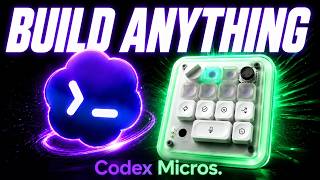
OpenAI Codex Micro: A Six-Key Pad Built to Run Agent Fleets
OpenAI's first hardware is a six-key macro pad for Codex, built with Work Louder. Each key shows a live agent status, a dial sets reasoning effort, and a joystick fires common workflows.
Every ChatGPT story we've covered — releases, tutorials, and analysis, summarised from the community and the official changelog. 34 and counting. New summaries are published as videos drop.
Looking for guides instead? See the ChatGPT hub.
OpenAI's first hardware is a six-key macro pad for Codex, built with Work Louder. Each key shows a live agent status, a dial sets reasoning effort, and a joystick fires common workflows.
ChatGPT's unified search now spans your whole account — every chat, project, file and image from one bar, with type filters, on web, iOS and Android. Paired with Projects it turns scattered history into a searchable knowledge base.
A plain-language rundown of four flagship models from mid-2026 — GPT-5.6 Soul, Fable 5, Grok 4.5, and open-weight GLM 5.2 — what each is tuned for, where to access it, and the trade-offs. Analysis, not a how-to.
Nate B Jones gave Codex (GPT-5.6) and Fable 5 the same open-ended task: inspect my work and pick your own problem to automate. Codex finished clean but stayed safe; Fable found the higher-leverage problem. Analysis, not a how-to.
A one-hour walkthrough of the Codex desktop 'super app' — plan mode, access levels, effort dials, model selection, local-vs-cloud runs, git branches, and connecting skills like Gmail to build websites and scheduled automations.
Nate B Jones on why bloated agent harnesses hurt Fable 5 and GPT-5.6 more than weak prompts — six principles for auditing and cleaning your instructions, skills, memory, and permissions.
Nate B Jones on choosing between GPT-5.6 and Fable 5 by your working style, not benchmarks (analysis, not a how-to).
Nick Saraev points GPT-5.6 Soul (via Codex CLI) at the Higsfield MCP and Netlify and lets it run an unattended loop — inventing 80+ physical products, generating images with GPT Image 2, animating ad videos, and auto-publishing sites, all with a self-QA pass.
A hands-on tour of the GPT-5.6 Codex update — now folded into the ChatGPT app. Julian Goldie builds websites, runs background computer-use to post on the web, edits video via a Descript plugin, installs an agent from GitHub, and tries the new 'pet' task tracker and effort levels.
Nate Herk gave GPT-5.6 Soul one prompt on Codex 'Ultra' and it produced a full narrated, avatar-led video — research, script, ElevenLabs/HeyGen/Hyperframes, and frame-by-frame self-checks. Plus the real token cost: ~450M tokens (~$300).
Julian Goldie routes the open-source Codex CLI through OmniRoute — a gateway with 93 providers (11 permanently free) and automatic fallback — so the same Codex agent keeps building when a free provider hits its rate limit.
Analysis, not a how-to: Nate B Jones on why OpenAI's restricted GPT-5.6 rollout, Claude Tag in Slack, Apple's Siri, GLM 5.2 and the Codex study all point to a shift from model wars to context wars.
A beginner's walkthrough of using ChatGPT for real work — drafting and refining emails, summarizing files, researching with web search, and generating structured plans — plus the paid Projects, Zapier, and Memory features.
OpenAI quietly made GPT-5.5 Instant the default ChatGPT model — 52.5% fewer hallucinations, ~3x faster on quick tasks, and 30% shorter responses. What it means for agent workflows.
OpenAI put Codex, its autonomous coding agent, inside the ChatGPT mobile app on iOS and Android — on every plan including free. Here's the new mobile workflow: remote control, push notifications, goals, side chat, and inline code review.
Nate B Jones builds 'Open Engine' — a shared work queue (Linear) plus a set of skills that lets Claude, ChatGPT/Codex, OpenClaw, and Hermes claim, work, and hand off tickets to each other and to teammates, so the human stops being the copy-paste glue between AI tools.
Kevin Stratvert demos the Granola MCP connector — pipe Zoom, Meet, and Teams transcripts into Claude, ChatGPT, and Claude Cowork to auto-generate proposals, action-item sheets, draft emails, and calendar events.
SkillOpt from Microsoft Research improves a markdown skill document with a rollout-reflect-gate loop instead of touching model weights. Walkthrough: install it, serve a local Qwen 3.5 4B with vLLM, and train a skill on the ALFWorld benchmark.
OpenAI's Codex picks up three updates: Sites (describe a page, get a live link), saved rate-limit resets you spend when you want, and an EEA/UK rollout adding computer use, a Chrome extension, and memories.
ChatGPT rolled out a revamped Scheduled Tasks feature with its own dedicated page, letting paid users (Go, Plus, Pro, Business, and Enterprise on web and mobile) schedule recurring background jobs — like a daily morning briefing, brand or competitor tracking, or an automatic AI-news scan.
Julian Goldie covers a new OpenAI Codex change: instead of losing your usage window when you hit a rate limit, you can now save rate-limit resets and spend them on your own schedule. Plus, Pro and Business users start with one free banked reset (redeemable within 30 days), and for two weeks Plus/Pro users can invite up to three friends to try Codex.
Nate B Jones on why OpenAI's Codex changes how the computer feels: you stop asking for answers and start handing the machine whole jobs. The chief-of-staff thread, goals, and the agent-first compute shift. Analysis, not a how-to.

OpenAI's head of finance technology explains how the company uses Codex for month-end workflows, executive slides, custom dashboards, vendor risk reviews, and journal entries — turning one-off processes into repeatable automated workflows.
OpenAI's Codex data analytics plugin acts as an agentic data analyst — gathering context across systems, building impact reports with charts, creating editable interfaces, and exporting to Google Slides in your company templates.
AICodeKing breaks down the Codex 4.0 app update: App Shots (Cmd+Cmd to capture the frontmost window), Goal Mode, Remote Computer Use, Plugin Sharing, and better browser annotations — showing how OpenAI is evolving Codex from a coding agent to a full workspace agent.
After 100 hours using both, Nate Herk gives an honest breakdown of Claude Code vs OpenAI Codex: where each excels, what they share, and which to pick for your workflow.
Nate B Jones analyzes why private equity, Anthropic, and OpenAI are converging on agentic workflow deployment. The real value is in the implementation layer—not the model—and PE firms are providing billions to capture it.
Skill Leap AI runs GPT-5.5 (extended thinking) against Claude Opus 4.7 (adaptive thinking) across 10 tasks — coding, writing, landing pages, business strategy, data analysis, and teaching. Google Gemini judges each round 1–10.
ChatGPT Workspace Agents let you build custom AI agents via chat or Agent Builder. Each agent gets its own skills (auto-generated), knowledge base, memory folder, and tool access — deployable in ChatGPT and Slack. Available on Business, Enterprise, and Education plans.
Andrew Brown's free Codex Essentials certification course on freeCodeCamp covers all Codex features with hands-on labs. Connects to a Claude Code Boot Camp on the same platform.
A short take from Nate B Jones on why — despite eye-popping token spend and strong open challengers like GLM 5.2 — there's still no tipping point away from Anthropic and OpenAI. Analysis, not a how-to.
Julian Goldie's avatar points OpenAI Codex at free model providers (Omniroot, HY3) via its model-provider setting, wrapped in a promoted Agent OS.
A brief look at the new OpenAI Developers plugin for Codex — it wires Codex to the OpenAI platform, helps manage API keys, scaffolds apps with the Responses API and Agents SDK, and debugs errors in plain language.
ChatGPT's latest update lets you generate visual charts directly in chat by typing plain-text requests — no Excel or file uploads required, works on mobile.
← Back to the full news digest · Browse the ChatGPT guides